

Managed Print Services for Alabama Businesses — Reduce Costs, Secure Documents, Improve Uptime
Managed Print Services (MPS) streamline every stage of office printing — from selecting and placing devices to supplies, maintenance, and usage reporting — so you get lower costs, stronger security, and smoother workflows. This guide shows how MPS tailored for Alabama organizations delivers measurable savings, tighter document and device protection, and higher staff productivity through fleet optimization and data-led reporting. Many companies face hidden printing costs, frequent emergency repairs, and unsecured machines that risk data exposure.
A well-designed MPS program swaps that unpredictability for controlled operating expenses, better uptime, and secure print release. Below you’ll find practical assessment steps, core service descriptions like automated supplies and proactive maintenance, notes on IT and cloud integration, and straightforward ROI guidance — all vendor-neutral so IT leaders and office managers can make confident choices about fleet management and secure printing in Alabama.
Why Choose Managed Print Services for Your Alabama Business?
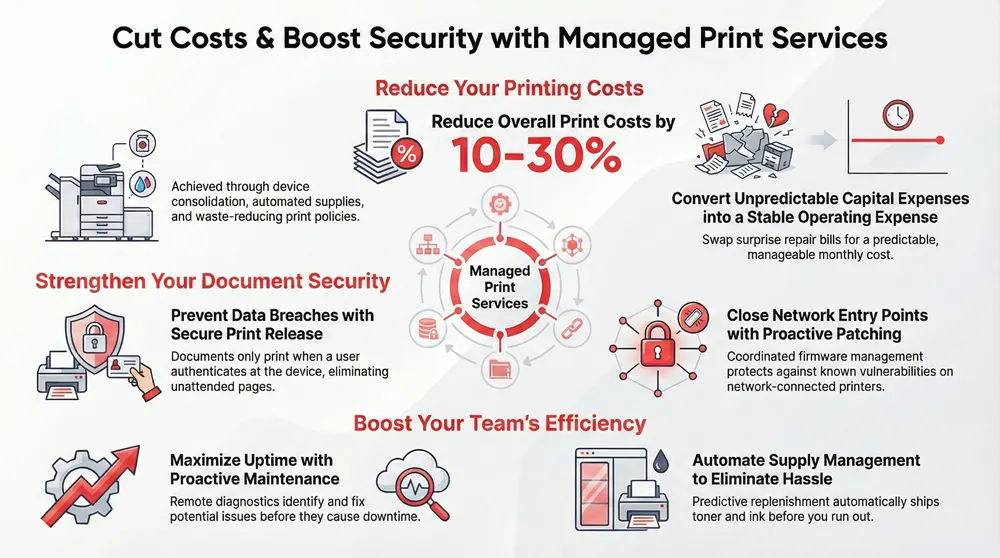
MPS is a coordinated program that lowers total print cost by consolidating devices, automating consumables, and enforcing usage policies — producing predictable OPEX and fewer device outages. Centralized print management converts irregular capital and repair spending into manageable operating expenses while reducing downtime and freeing staff from frequent printer issues. MPS hardens document security through secure release and firmware management, reduces waste to support sustainability goals, and simplifies vendor oversight with consolidated reporting. The sections that follow unpack the specific cost, efficiency, and security gains that make MPS a practical fit for Alabama organizations.
Security matters: unmanaged printers can be an overlooked entry point into your network if they aren’t properly controlled.
Office Printer Vulnerabilities & Enterprise Network Security
Office printers can expose many attack vectors. Because modern printers run software and often connect to networks, an unpatched device can let attackers gain access or disrupt systems. Reviewing past printer attacks shows recurring patterns and highlights practical mitigation steps. This paper reviews those incidents and offers a consolidated checklist businesses can use to reduce risk and secure their devices.
Vulnerabilities in Office Printers, Multifunction Printers (MFP), 3D Printers, and Digital Copiers: A Gateway to Breach Our Enterprise Network, EB Blancaflor, 2023
When you’re ready to evaluate MPS, Automated Business Machines (ABM) offers regional expertise in copier and printer leasing, repair, managed print services, managed IT, and document management integrations. ABM works with major hardware partners and can provide an on-site consultation or quote to assess your current environment and recommended next steps.
How Can MPS Reduce Printing Costs and Boost Efficiency?
MPS lowers costs through three core levers: fleet consolidation, automated supplies, and policy-driven controls that reduce waste. Consolidation removes redundant small printers and replaces them with multifunction devices sized to departmental needs, which cuts per-page costs and simplifies support. Automated toner and ink replenishment reduces ordering time and avoids premium emergency shipments, while remote monitoring identifies inefficient devices and enforces duplex, grayscale, or quota policies to curb consumable use. In practice, consolidating a mixed fleet and standardizing double-sided defaults can reduce consumables and support costs by a conservative 10–25% annually, depending on your starting point.
Those savings are reinforced by detailed reporting and analytics that reveal further optimization opportunities and by SLAs that ensure improvements stick.
What Security Benefits Does MPS Offer for Alabama Businesses?
MPS strengthens security with device-level access controls, network segmentation, and secure print release so sensitive documents aren’t left exposed. Secure release requires user authentication at the device before printing, eliminating unattended pages and lowering compliance risk for regulated data. Coordinated firmware management and patching close known vulnerabilities, and telemetry integrated with IT monitoring can flag unusual print activity that might indicate data theft or credential misuse. Centralized logging and reporting make audits simpler and let security teams treat printers as a managed part of the infrastructure.
New secure release options — like QR-code release and eID-based authentication — add practical, user-friendly second-factor confirmation at the device.
Secure Pull Printing with QR Codes & eID
A software-focused pull-print solution can use QR codes or electronic ID cards as a second-factor authenticator for print release, combining convenience with stronger document confidentiality.
Secure Pull Printing with QR Codes and National eID Cards: A Software-oriented Design and an Open-source Implementation, M Leonelli, 2021
When device security is aligned with broader IT policies and incident response plans, print infrastructure becomes a controlled, auditable element of your organization’s risk posture. We cover integration details in the next section.
Comprehensive Managed Print Services Offered in Alabama

Comprehensive MPS includes assessment, optimization, maintenance, supplies, reporting, and document management — each designed to improve uptime and lower total cost of ownership. A typical program starts with a baseline inventory and usage analysis, then delivers a prioritized roadmap: device standardization, SLA-backed maintenance, automated consumables fulfillment, and advanced reporting for continuous improvement. Together these services reduce administrative load, lower per-page costs, and keep devices secure and available. The table below summarizes core services and their operational benefits so you can compare options quickly.
| Service | Includes | Key Benefit |
|---|---|---|
| Print Environment Assessment | Device inventory, usage analysis, cost baseline | Reveals consolidation opportunities and immediate savings |
| Proactive Maintenance | Remote diagnostics, scheduled service, on-site repairs | Boosts uptime and lowers emergency service fees |
| Automated Supplies Management | Predictive replenishment, OEM/compatible options | Prevents stockouts and cuts consumables admin time |
Each element reduces your overall print burden and drives down the total cost of ownership. The sections that follow explain how discovery and operations deliver those results.
ABM supports equipment leasing and repairs and integrates with document management platforms such as Questys, DocForm, and Encompass. We partner with hardware brands including HP, Lexmark, Toshiba, Fujitsu, and Xerox to match devices to client needs — contact ABM for details on service scope and financing.
What Does Print Environment Assessment and Optimization Include?
An assessment documents existing devices, users, and costs so you can prioritize right-sizing and placement to cut waste and streamline workflows. Typical steps: full device inventory, page-volume and color vs. monochrome analysis, consumables usage profiles, and a cost baseline that captures lease, maintenance, and supplies spend. The outcome is a prioritized plan recommending consolidation, default print policies, and placement changes to reduce walk-time and improve departmental efficiency. If you want a quick self-check, watch for high device-to-user ratios, frequent emergency toner orders, or unmanaged networked printers — all signs an audit will pay for itself.
The formal assessment then moves into implementation planning and SLA definitions so the changes deliver sustained results and predictable operating expenses.
How Does Proactive Maintenance and Supplies Management Work?
Proactive maintenance combines remote diagnostics, scheduled preventive visits, and fast on-site repair to minimize downtime and extend device life while keeping costs predictable. Remote monitoring collects device health metrics and auto-creates service tickets when thresholds are met so technicians can intervene before users are impacted. Supplies management uses consumption telemetry to trigger replenishment before you run out, cutting emergency shipments and administrative work. SLAs define response and repair targets so IT can plan around reliable availability.
These capabilities lower break-fix spend and free internal teams to focus on higher-value IT projects instead of reactive printer support — which is why many customers pair MPS with managed IT services.
How Does Managed Print Services Integrate with IT Solutions in Alabama?
MPS ties into IT by aligning device security, network policy, and support workflows so printers aren’t treated as isolated peripherals. When print management connects to asset inventories and SIEM/logging systems, teams gain visibility into print events and can consistently enforce segmentation and access controls. Consolidated billing and single-vendor coordination cut procurement complexity, while shared remote diagnostics shorten incident resolution because technicians can see device and network telemetry together. These integrations make MPS a natural extension of managed IT for organizations centralizing operations.
The following subsections cover the benefits of a unified approach and how cloud-managed print solutions extend remote management and hybrid work support.
What Are the Advantages of Combining MPS with Managed IT Services?
Pairing MPS with managed IT strengthens security, speeds problem resolution, and simplifies vendor management through shared diagnostics and a single escalation path. Unified contracts reduce admin overhead and consolidate reporting so finance and IT share one view of device spend and performance. Shared monitoring lets technicians correlate printer events with network incidents to cut mean time to repair and reduce user downtime. For compliance-led organizations, combined policies ensure print logs and access controls meet audit requirements without duplicate processes.
Those operational efficiencies are why many clients choose one partner for both print and IT management: fewer handoffs, clearer accountability, and better visibility.
How Does Cloud-Based MPS Enhance Remote Print Management?
Cloud-managed print centralizes device configuration, user access, and analytics in a platform administrators can use from anywhere, reducing the need for on-site visits and supporting hybrid work. Cloud portals let admins push configuration changes, enforce role-based access for secure print release, and view real-time usage dashboards to refine policies and control costs. Mobile and guest printing workflows are easier to manage through cloud connectors that maintain security and tracking regardless of location. Good cloud MPS implementations include encryption in transit and at rest and clear data-handling practices to meet privacy requirements.
Cloud features lower on-site admin burdens and produce richer data for ongoing policy and placement improvements.
Which Alabama Cities Are Served by ABM’s Managed Print Services?
ABM offers regional coverage designed for quick response and scalable MPS across nearby markets; confirm local availability and expected response times when you engage. Larger metros usually have full assessment, proactive maintenance, and leasing options, while smaller markets often receive a remote-first service model with scheduled on-site visits for escalations. The table below shows typical services in representative Alabama cities and what to expect for response approaches.
| City | Services Available | Typical Response Notes |
|---|---|---|
| Birmingham | Assessment, MPS, leasing, repairs | On-site service and scheduled visits available |
| Mobile | Assessment, proactive maintenance, supplies | Local technicians supported by remote monitoring |
| Huntsville | MPS, reporting, document integrations | Fast escalation paths to field service teams |
This city-level snapshot sets expectations for local service availability and how remote monitoring supports SLAs.
After confirming coverage, request a tailored assessment to understand local service levels and SLA commitments; ABM can confirm availability for specific locations and schedule evaluations as needed.
What Services Are Available in Birmingham, Mobile, and Huntsville?
In larger Alabama markets like Birmingham, Mobile, and Huntsville, clients typically have access to the full MPS portfolio: environment assessments, fleet management, leasing, proactive maintenance, automated supplies, and document management integrations. Field teams handle scheduled preventive maintenance and quick on-site repairs while remote diagnostics and automated replenishment keep uptime high. Advanced reporting and workflow integrations help reduce paper handling and speed approvals. For a city-specific plan and cost estimate, contact a regional representative for an assessment tailored to device counts and workflows.
Local availability and SLA response times vary by city and service model, so the assessment phase is key to aligning expectations and costs with operational needs.
How Does ABM Support Businesses in Montgomery, Auburn, and Dothan?
In smaller Alabama markets such as Montgomery, Auburn, and Dothan, ABM typically provides a remote-first MPS approach that emphasizes monitoring, automated supplies, and scheduled on-site service when required. Flexible leasing and managed agreements adapt to local business size. Remote monitoring handles most preventive needs and supplies forecasting while regional dispatch arranges field service for escalations and installations. This hybrid model keeps costs predictable for smaller organizations while preserving access to full-service repairs when necessary. Prospective clients should request coverage confirmation and a customized plan to understand response windows and service tiers.
Our agreements are designed to scale up or down as device counts and business needs change.
What Are the Cost Savings and ROI of Managed Print Services in Alabama?
MPS typically reduces consumable and support costs and converts unpredictable expenses into predictable OPEX; payback varies with fleet size and existing inefficiencies. Conservative industry guidance places print cost reductions in the 10–30% range after optimization, driven by lower consumables spend, fewer emergency calls, and fewer devices. Calculating ROI compares your current total cost of ownership — leases, maintenance, supplies, and labor — against projected managed service costs and factors in productivity gains from improved uptime. The table below offers a simplified comparison of cost models to help decision-making.
Knowing the economics of MPS — pricing models and how customers value services — helps you maximize financial benefits.
Managed Print Services Pricing & Customer Valuation
Managed services for IT and print are a growing market. This study examines contractual relationships between MPS providers and institutional customers, showing patterns in demand and valuation. Findings indicate printing demand is relatively price-insensitive across observed contracts and that customer valuation is influenced by broader market perspectives. The research also notes that larger fleets can affect population-level pricing dynamics.
Empirical study on managed print services pricing, J Ning, 2014
| Model | Typical Cost Components | ROI Impact |
|---|---|---|
| Break-Fix | Ad hoc repairs, emergency supplies | High variability; slower ROI |
| Lease Only | Capital leases, separate support | Improved predictability; moderate ROI |
| Managed Print Service | Consolidated lease, SLA, supplies, reporting | Most predictable; fastest ROI when optimized |
This comparison shows how managed services typically reduce variability and administrative overhead, often shortening payback timelines and improving budgeting accuracy.
The sections below quantify typical savings and provide example outcomes to help you estimate MPS value for your operation.
How Much Can Alabama Businesses Save with MPS?
Savings depend on your starting point, but conservative estimates place typical reductions at 10–30% across consumables, service, and admin labor once an MPS program is in place. Key drivers: device consolidation, fewer emergency toner orders, and automated supplies ordering that cuts administrative time. For example, an organization with $100,000 in annual print-related spend that reduces costs by 15% would save $15,000 plus gains from improved uptime. Factors that influence results include device mix, current waste levels, and contract terms.
Start with a baseline audit to quantify your TCO and model projected savings conservatively before procurement.
What Case Studies Demonstrate MPS Benefits in Alabama?
Local outcomes vary, but common results include: a mid-sized office cutting device counts by 30%, lowering consumables spend by 18%, and improving uptime via SLA-backed service; another client standardized on MFPs integrated with document management and reduced paper handling by 25% while accelerating approvals. These examples follow a clear pattern: assessment identifies opportunities, implementation consolidates devices and policies, and managed operations sustain gains through monitoring and replenishment. Ask your provider for relevant case studies or comparable market examples during the assessment phase.
Clear case summaries help stakeholders see how similar organizations realized cost and operational improvements through MPS.
Frequently Asked Questions
What types of businesses can benefit from Managed Print Services (MPS)?
MPS suits a wide range of organizations — from small businesses to large enterprises. Any company that relies on printing for operations can benefit. Sectors with higher printing needs, such as healthcare, education, finance, and legal, often see significant cost and security gains. By optimizing print environments, businesses improve productivity, simplify workflows, and strengthen compliance — making MPS a flexible solution across industries.
How does MPS improve document security beyond secure release printing?
Beyond secure release, MPS enhances security through firmware management (keeping devices patched), network segmentation (isolating printers from sensitive systems), and user authentication (logins, ID cards, or single sign-on). Centralized logging and monitoring detect unauthorized access attempts and build an auditable trail. Together these controls create a layered security posture that protects sensitive information throughout the printing lifecycle.
What are the environmental benefits of using Managed Print Services?
MPS supports sustainability by cutting paper waste and energy use. Consolidating devices, enforcing duplex defaults, and setting print quotas reduce unnecessary printing. Many providers also offer energy-efficient hardware. Automated supplies management reduces waste by ordering only what’s needed. Overall, MPS helps organizations reach sustainability goals while keeping operations efficient.
Can MPS be customized to fit specific business needs?
Yes. MPS is highly configurable. Providers offer flexible service tiers so you choose the services you need — equipment leasing, maintenance, reporting, or document workflow integration. Customization extends to device selection, print policies, and security settings based on company size, industry, and operational goals. That flexibility ensures the solution aligns with workflows and budgets.
What role does data analytics play in Managed Print Services?
Data analytics is central to MPS. Reporting tools track usage patterns, pinpoint inefficiencies, and reveal savings opportunities. Analytics guide decisions on device placement, policy changes, and resource allocation. That data-driven approach both reduces costs and improves productivity by ensuring print resources match actual needs.
How can businesses assess their current print environment before implementing MPS?
Run a print audit: inventory devices, analyze usage patterns, and total the costs of leases, supplies, and maintenance. Look for red flags like high device-to-user ratios or frequent emergency toner orders. That data identifies consolidation and optimization opportunities and informs realistic goals for savings and efficiency.
What are the typical contract terms for Managed Print Services?
Contract terms vary by provider and scope. Typical agreements define duration, pricing structure, and SLAs for response and repair times. Many offers include flexible terms so services can scale. Review contract details carefully — including early-termination terms, renewal processes, and what’s included in per-page or managed fees — before signing.
What Is Included in Managed Print Services?
MPS commonly includes equipment management and leasing, supplies fulfillment, proactive maintenance and on-site repair, advanced reporting and analytics, and security controls like secure release and firmware updates. Many programs also integrate document management to reduce paper workflows, recommend consolidation, and define SLAs for response and uptime. Scope varies by provider and can be tiered to meet budget and operational needs — confirm included brands, consumable policies, and SLA metrics during the assessment.
Providers may also offer lease financing and document workflow consulting as part of broader office technology services.
How Do I Choose the Right MPS Provider in Alabama?
Evaluate local support capability, SLA terms, brand partnerships, security features, and pricing transparency to match your priorities and risk tolerance. Use a checklist: response times, whether monitoring and automated supplies are standard, integration with your IT systems, partner hardware brands, and clarity on what’s included in per-page or managed fees. Request sample reports, references, and a pilot or assessment to validate savings and SLA performance. The provider should document implementation steps, warranties, and escalation paths so expectations are clear before you sign.
If you want a tailored assessment and quote, Automated Business Machines (ABM) offers managed print evaluations, leasing, repair services, and document management integrations with partners like HP, Lexmark, Toshiba, Fujitsu, and Xerox. Contact ABM to start a consultation, confirm city-specific coverage, and review SLA options. ABM combines regional field service with remote monitoring and can provide detailed proposals and financing choices.
- Benefits Checklist: Use this to evaluate provider proposals.Confirm SLA response and repair times.Verify automated supplies and predictive maintenance are included.Check security controls like secure-print release and firmware management.
- Implementation Steps: Typical phased approach for MPS.Baseline assessment and device inventory.Pilot consolidation and policy rollout.Scale deployment and ongoing optimization.
- Questions to Ask: Essential procurement questions.How are consumables billed and replaced?What are the escalation procedures for repeated failures?Can you integrate with our document management system?
This table summarizes common financial benchmarks and expectations to guide planning and benchmarking for MPS initiatives.
We’ve outlined a practical framework, checklists, and comparison tables to help Alabama organizations assess and implement managed print services that cut costs, tighten security, and improve efficiency. If you’d like a tailored assessment or written proposal, Automated Business Machines (ABM) can schedule an evaluation, offer device leasing, and design managed services that match local needs and enterprise requirements — contact ABM to arrange an on-site review and get a customized quote by phone.
Earn your airdrop on Aster https://is.gd/ZceEI6
Earn your airdrop on Aster https://is.gd/ZceEI6
Enter your invite code to earn your airdrop on Aster https://is.gd/ZceEI6
Earn your airdrop on Aster https://is.gd/ZceEI6
Special ability to earn $ASTER bonus https://is.gd/CGTnqR
Turn your traffic into cash—join our affiliate program!
Earn up to 40% commission per sale—join our affiliate program now!
Drive sales, earn commissions—apply now!
Promote our products—get paid for every sale you generate!
Join our affiliate program and watch your earnings skyrocket—sign up now!
Be rewarded for every click—join our affiliate program today!
Start earning on every sale—become our affiliate partner today!
Tap into unlimited earnings—sign up for our affiliate program!
Boost your profits with our affiliate program—apply today!