
Birmingham, AL Managed Print Services & Cost Savings — Automated Business Machines
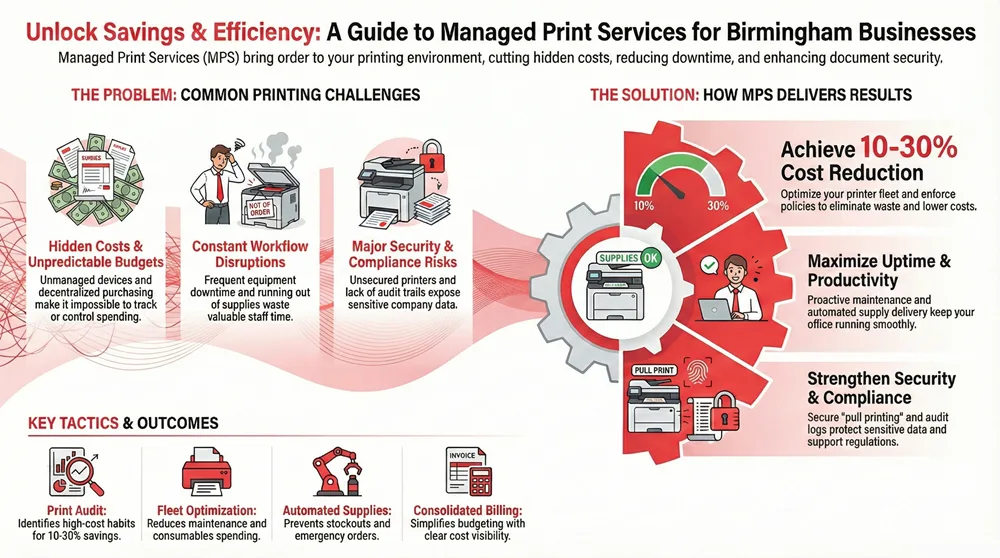
Managed print services (MPS) bring order to a company’s printers, copiers, supplies, and document flows so Birmingham organizations can cut costs and run more smoothly. This guide walks through what MPS is, why a managed approach matters for local businesses, and how focused tactics—like fleet optimization, automated supplies, and document management—produce measurable savings and better uptime. You’ll get a clear look at how MPS works, common print problems we see in Birmingham offices, and practical steps for assessment, rollout, and ongoing governance. We also cover secure and sustainable printing, compare document-management options, and outline the typical MPS lifecycle from audit to continuous improvement.
Where it helps, we note how Automated Business Machines supports Birmingham companies with on-site assessments, vendor-neutral recommendations, and customized optimization roadmaps that simplify budgeting and lower cost-per-page. That context helps leaders pick solutions that fit IT and sustainability goals.
What Are Managed Print Services and Why Do Birmingham Businesses Need Them?
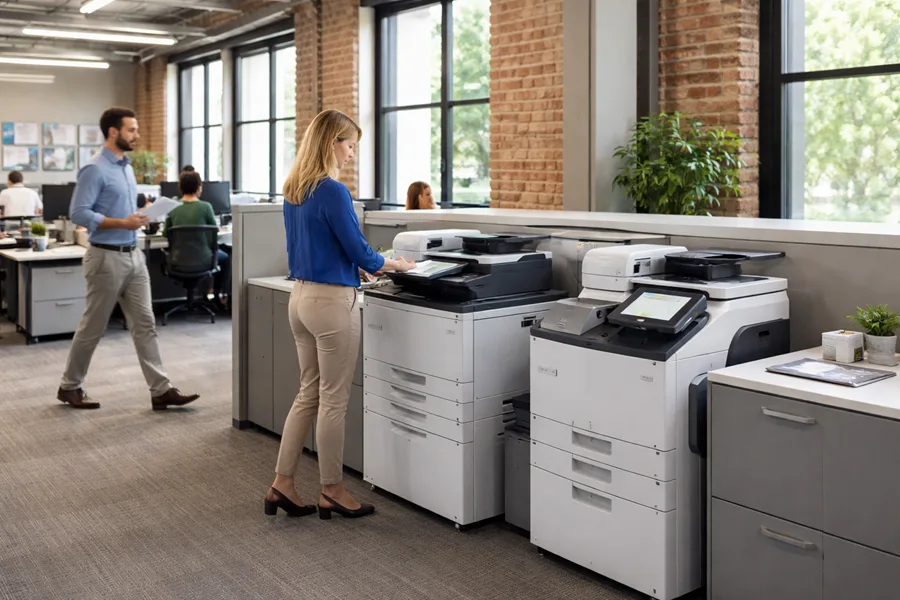
Managed print services (MPS) are a coordinated program of assessment, device management, supplies provisioning, maintenance, and reporting designed to reduce total printing costs and streamline document workflows. MPS starts by measuring usage, rightsizing the device fleet, enforcing print policies, and automating supplies and service so organizations cut waste and gain predictable expenses.
For Birmingham businesses, the immediate benefits typically include a lower cost-per-page, less downtime, stronger security controls, and clearer visibility into how and where printing happens so budgets stay under control. By treating printing as a managed service rather than an unmanaged cost center, MPS aligns device and workflow decisions with operational priorities and compliance needs. The next section explains how those mechanics translate into real efficiency and savings in everyday office settings.
Automated Business Machines will perform a local assessment and deliver a no-obligation optimization roadmap tailored to Birmingham offices; get started by choosing to request a formal assessment or quote.
How Do Managed Print Services Improve Office Efficiency and Reduce Costs?
MPS improves efficiency by optimizing where devices live, consolidating multifunction printers, and setting defaults that cut unnecessary color, single-sided, or high-resolution printing. Those operational changes reduce cost-per-page and shrink the number of devices that require service, lowering consumable spending and administrative work. In real-world examples, organizations often realize savings in the 10–30% range from device rightsizing and policy enforcement. Better monitoring and scheduled preventive maintenance also reduce technician visits and unplanned downtime, which translates into more productive staff time. Knowing how these levers work makes it easier to prioritize which printers to consolidate and which paper workflows to digitize next.
Independent research reinforces that managed print strategies can optimize costs and fleet performance.
Managed Print Services Pricing & Fleet Optimization
This study examines managed services in the context of MPS by analyzing contracts between providers and institutional customers. The authors find that customers’ print volume is largely insensitive to service price within the observed contracts and that individual valuations tend to follow the broader population trend. Notably, the perceived value of managed print decreases as fleet size grows, pointing to the bargaining power of larger organizations.
Empirical study on managed print services pricing, J Ning, 2014
What Common Printing Challenges Do Birmingham Businesses Face?
Birmingham offices commonly struggle with untracked printing, inconsistent supplies inventory, and frequent equipment downtime that disrupts workflows and raises indirect labor costs. Security gaps are also typical: open print queues, no user authentication, and missing audit trails create exposure for sensitive data and complicate compliance. Other issues include decentralized supply purchasing, a mix of manufacturers and drivers, and weak reporting that makes budgeting difficult. Each of these challenges is solvable with targeted MPS steps—inventory-led consolidation, centralized supplies, secure release printing, and standardized reporting—that restore control and visibility. Fixing these pain points is often the first step toward broader document management and process automation.
How Does Automated Business Machines Deliver Cost Savings Through Managed Print Services in Birmingham?
We deliver cost savings by combining data-driven assessments, vendor-neutral fleet recommendations, and proactive supply and maintenance management to eliminate waste and lower total cost of ownership. The engagement starts with a detailed usage analysis and device inventory, moves to rightsizing and policy recommendations, and includes consolidated billing and reporting so budgets are easier to manage. ABM focuses on measurable results—lower cost-per-page, less consumable spend, and fewer emergency service calls—while recommending proven equipment that matches each client’s needs. The outcome is clearer budgeting and better uptime that reduce operating costs.
This comparison table summarizes the main cost-saving tactics and typical outcomes.
| Initiative | Characteristic | Typical Outcome |
|---|---|---|
| Print Audit | Finds underused devices and high-cost habits | 10–30% cost reduction range |
| Fleet Optimization | Right-sizes devices and standardizes models | Lower maintenance and consumables spend |
| Supply Management | Automated replenishment and inventory control | Fewer stockouts and emergency orders |
| Consolidated Billing | One monthly statement with full reporting | Simpler budgeting and clearer cost visibility |
Each tactic addresses a different cost driver; the greatest savings come when the program combines all elements.
What Is Included in ABM’s Comprehensive Print Assessment and Fleet Optimization?
A full print assessment includes device discovery, meter reads, usage by user or group, supplies consumption patterns, and a site visit to observe workflows and device placement. We turn those inputs into a prioritized optimization roadmap recommending consolidation, right-sized multifunction units, and policy changes like duplex-by-default and default black-and-white printing. Deliverables typically include estimated cost savings, a recommended device mix by location, and an implementation timeline with ROI estimates. The assessment also flags opportunities to add document capture or workflow software where printing signals deeper process inefficiencies. These outputs give leaders clear actions and expected outcomes before they commit to changes.
How Does Proactive Supply Management and Maintenance Minimize Downtime?
Proactive supply management uses usage analytics and automatic replenishment so toner and consumables arrive before they run out, avoiding costly emergency orders and downtime. Preventive maintenance tackles wear-and-tear before it becomes disruptive, and remote monitoring surfaces issues often before users notice them. Service-level agreements set response times and parts turnaround so uptime becomes predictable. Together, these practices reduce unplanned service calls, extend device lifecycles, and remove routine supply ordering and basic troubleshooting from internal teams so IT can focus on higher-value projects.
Automated supply-chain approaches are central to efficient print operations, as demonstrated by research into systems like MIDAS.
Automated Supply Chain Management for Print
The MIDAS system is an automated supply-chain platform that lets customers, manufacturers, and suppliers work together online. MIDAS is designed to improve coordination and responsiveness across the supply chain, reducing shortages and lead times.
An automated supply chain management system and its performance evaluation, F Kart, 2012
What Transparent Pricing Models and Budget Controls Does ABM Offer?
Common pricing models in MPS include per-page billing, all-inclusive service packages, and equipment leasing, each matching different budget preferences and usage patterns. Per-page pricing makes variable costs clear and works well if you want to pay for output only. All-inclusive plans roll maintenance and supplies into a fixed monthly fee for predictable forecasting. ABM supports consolidated billing and detailed reporting that break costs down by department or device so managers can spot trends and act. The right model depends on print volume, whether you prefer CAPEX or OPEX treatment, and how much budget predictability you need.
How Can Birmingham Offices Enhance Productivity with Managed Print Services?
MPS boosts productivity by simplifying document capture, automating routing and approvals, and linking printers to document-management systems to remove manual steps. The approach is simple: digitize recurring paper tasks, route captured documents into searchable repositories, and use intelligent indexing to speed retrieval. That reduces time spent filing, searching, and reprinting, and improves collaboration for hybrid teams that need secure remote access. The table below compares common document-management platforms and their core strengths to help Birmingham offices choose the right fit.
| Solution | Primary Use Case | Key Benefit |
|---|---|---|
| Questys | Enterprise retention and retrieval | Robust records management and indexing |
| DocForm | Capture and form automation | Turns paper forms into automated workflows quickly |
| Encompass | End-to-end document lifecycle | Integrates with business apps for approvals |
This comparison helps IT and operations leaders align platform choice to the most urgent workflow needs, speeding time-to-value when integrated with MPS.
Which Document Management Solutions Streamline Workflows?
Questys, DocForm, and Encompass each cover parts of the document lifecycle: capture, indexing, storage, and workflow automation. Questys is strong for records retention and compliance-focused indexing; DocForm converts paper forms into structured digital data to accelerate approvals; Encompass supports broader lifecycle needs and integrates with line-of-business systems. Pairing one of these platforms with device-based scanning and secure release printing reduces manual filing, stops redundant printing, and speeds information retrieval—leading to measurable time savings and fewer errors. Automated Business Machines partners with these vendors to recommend and deploy the best-fit solution and ensure smooth integration with existing fleets and policies.
How Does MPS Reduce IT Department Workload and Support Hybrid Work Models?
MPS lowers IT burden by centralizing driver and firmware management and using remote monitoring to troubleshoot without a helpdesk ticket. Central dashboards send alerts for low supplies, device faults, and performance trends so IT teams act proactively. For hybrid workers, secure release printing and mobile print tools let employees send jobs from anywhere and release them at the office securely, preventing stranded prints and data exposure. These capabilities cut repeat helpdesk requests and free IT to work on strategic projects while offering reliable print services for on-site and remote staff.
What Secure and Sustainable Printing Solutions Are Available for Birmingham Businesses?
Secure and sustainable printing combines technical controls—authentication, encryption, and audit logging—with policies and device choices that lower energy and material use. Security features stop unauthorized access and create auditable trails for compliance, while sustainability measures—device consolidation, duplex defaults, and cartridge recycling—cut environmental impact. The table below maps features to compliance and environmental benefits so you can see how policy and tech work together.
| Feature | Compliance / Benefit | Example Implementation |
|---|---|---|
| Secure Pull Printing | Minimizes data exposure and supports audits | User authentication at the device before job release |
| Audit Logging | Records document access for compliance | Centralized logs retained to policy |
| Duplex-by-Default | Reduces paper use and energy per job | Administrative default on printers |
| Recycling Programs | Reduces waste and lifecycle footprint | Cartridge return and remanufacture programs |
That mapping shows how technical controls and policies work together to meet security obligations and sustainability goals.
How Does ABM Ensure Print Security and Regulatory Compliance?
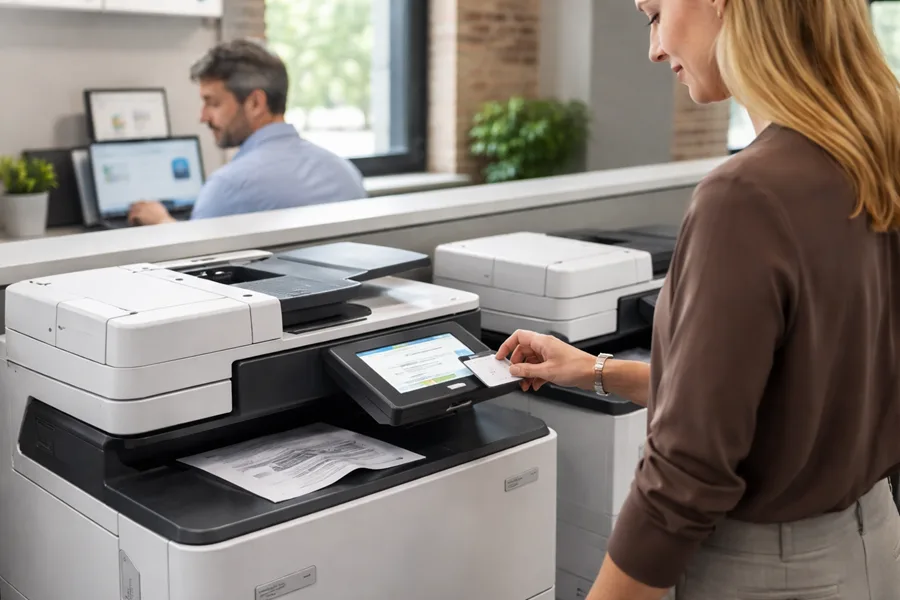
Automated Business Machines applies access controls, secure release printing, and encryption in transit to limit unauthorized access to sensitive documents and support records-retention obligations. We enable audit logging and reporting so organizations can show who printed or accessed documents—important when handling PII or other regulated data. Ongoing monitoring and periodic security reviews keep settings current as policies and threat profiles change. These layers protect document workflows while preserving access for authorized users.
What Sustainability Practices Does Managed Print Services Promote?
MPS encourages sustainability through device rightsizing to cut idle power use, duplex-by-default to lower paper consumption, and consumables programs that prioritize remanufactured or recyclable cartridges. Usage reporting helps quantify reductions in materials and related carbon impact, supporting corporate sustainability reporting. Practical steps include firm print policies, staff training on digital alternatives, and cartridge return programs that close the materials loop. These actions both shrink environmental footprint and deliver additional cost savings through lower consumable use.
What Is the Managed Print Services Process for Birmingham Businesses with Automated Business Machines?
The MPS engagement with ABM follows a clear sequence: assessment, roadmap, implementation, and ongoing support and optimization. This approach keeps decisions data-driven, prioritized by ROI, and executed with minimal disruption. The numbered steps below summarize the typical path from discovery to continuous improvement and offer a predictable timeline for stakeholders.
- Assessment and data collection across the fleet to establish baselines and uncover opportunities.
- Optimization roadmap with prioritized recommendations and ROI estimates to guide choices.
- Implementation of approved changes, including device deployment and policy configuration.
- Ongoing support with monitoring, reporting, and periodic reviews to preserve and grow savings.
How Does ABM Conduct Print Audits and Develop Optimization Roadmaps?
ABM’s audits combine meter reads, supply consumption, device inventory, and user behavior using automated data collection plus onsite observation to create a complete picture. Analysts flag underused or costly devices, recommend consolidation opportunities, and model expected savings for several scenarios. Roadmaps favor quick wins first—policy tweaks and supply centralization—then plan medium-term device refreshes or software integrations. Deliverables include cost-savings projections, a recommended device mix by location, and an implementation timeline so stakeholders can decide with transparent financial expectations.
What Are the Implementation and Continuous Support Phases?
Implementation covers device deployment, driver and firmware standardization, user training on new workflows, and configuration of security and mobile-printing features. After rollout, continuous support focuses on monitoring utilization, managing supplies automatically, and scheduling preventive maintenance under agreed SLAs. Regular reporting—monthly usage and quarterly strategic reviews—keeps the program aligned with business goals and surfaces new efficiency opportunities. That cadence helps preserve initial savings and lets the program evolve with changing needs.
Why Choose Automated Business Machines for Managed Print Services in Birmingham?
Automated Business Machines pairs local assessments, vendor-agnostic recommendations, and experience aligning print programs with business objectives to deliver measurable savings and operational stability. We work with recognized equipment and software partners to match technology to process needs—not to force a one-size-fits-all solution. Our emphasis on assessment-driven roadmaps, consolidated billing, and ongoing optimization helps organizations turn technical changes into budget certainty and improved uptime. The points below summarize why Birmingham organizations choose an experienced partner for MPS.
- Assessment-Driven Planning: Decisions grounded in data and prioritized by expected ROI.
- Vendor-Neutral Recommendations: Technology chosen for fit, not vendor preference.
- Ongoing Optimization: Regular reviews and reporting to maintain savings and adapt to change.
What Cost Savings and Efficiency Benefits Differentiate ABM’s MPS?
A managed print program typically delivers lower cost-per-page through rightsizing, fewer emergency service calls via preventive maintenance, and reduced consumable spend through automated supply management. Efficiency gains appear as less time spent filing and faster retrieval when document workflows are digitized, and as reduced IT overhead thanks to centralized monitoring and support. Typical savings fall within industry norms—often 10–30%—and ABM emphasizes transparent reporting so clients can verify realized savings against projections. That measurable approach helps organizations reallocate resources to higher-value work.
How Do ABM’s Certified Technicians and Brand Partnerships Enhance Service Quality?
ABM’s service model relies on trained technicians and partnerships with established hardware and software brands to ensure fast resolution and cross-environment compatibility. Certified technicians deliver consistent maintenance and troubleshooting, while vendor relationships let ABM source parts and recommend best-fit devices such as multifunction printers and scanners from trusted manufacturers. The result is higher uptime, predictable service, and access to equipment options that meet specific operational needs—supporting timely deployments and dependable support for Birmingham clients.
Frequently Asked Questions
What are the key benefits of implementing Managed Print Services (MPS) for small businesses in Birmingham?
For small businesses in Birmingham, MPS reduces printing costs by optimizing device use and automating supply management. It improves operational efficiency by streamlining document workflows and cutting downtime with proactive maintenance. MPS also strengthens security through access controls and audit trails, which helps with data-protection compliance. Overall, MPS aligns printing with broader business priorities, improving resource management and delivering measurable cost savings.
How can businesses measure the success of their Managed Print Services implementation?
Success is best tracked with clear KPIs: reductions in cost-per-page, total printing spend, and equipment downtime, plus improved user satisfaction and time saved on document handling. Regular reporting and periodic audits show whether the program meets goals like waste reduction and compliance. By reviewing these metrics, businesses can decide where to tighten policies or invest in further automation.
What role does employee training play in the success of Managed Print Services?
Employee training is essential: it ensures staff know new workflows, device features, and print policies. Well-trained users take full advantage of MPS features such as secure release and mobile printing, which reduces errors and boosts productivity. Training also reinforces policy compliance and drives higher returns from the program. Organizations that invest in training typically see faster adoption and stronger results.
What are the environmental benefits of adopting Managed Print Services?
MPS drives environmental benefits by encouraging duplex printing, reducing the number of devices, and using remanufactured or recyclable cartridges. Optimizing device use and consolidating printers lowers energy consumption and carbon footprint. Reporting features let organizations measure resource use and track progress toward sustainability goals. In short, MPS reduces environmental impact while lowering operating costs.
How does MPS support compliance with data protection regulations?
MPS helps meet data-protection requirements through secure release printing, user authentication, and audit logging that track document access and printing activity. These features are useful for regulations such as GDPR or HIPAA. Regular monitoring and updates to security settings help organizations stay aligned with evolving compliance needs, protecting sensitive information without hindering business workflows.
What should businesses consider when choosing a Managed Print Services provider?
When evaluating an MPS provider, look for proven local experience and industry-relevant track records. Prefer vendors that offer vendor-neutral recommendations so solutions are chosen for fit, not brand loyalty. Assess their approach to ongoing support and optimization, since continuous improvement is key to maximizing ROI. Finally, check pricing transparency and the breadth of services—security, sustainability, and reporting should be part of the offering.