
Copier leasing and rental give Atlanta businesses flexible access to printers and copiers without a large upfront purchase — providing predictable monthly costs and simpler technology refresh cycles.
This guide walks through how leasing and short-term rentals work, the device categories and brands commonly available to Atlanta offices, and how managed print services and local support fit into a full document-management approach. You’ll find clear explanations of operational benefits, typical lease structures, equipment selection criteria, and how nearby service affects uptime and total cost of ownership. We also map practical steps for requesting accurate quotes, compare short-term rentals with long-term leases, and cover security and maintenance considerations that matter for compliance and continuity. Throughout, we show how a regional provider like Automated Business Machines (ABM) can deliver flexible terms and onsite support to realize these advantages.
What Are the Benefits of Copier Leasing for Atlanta Businesses?
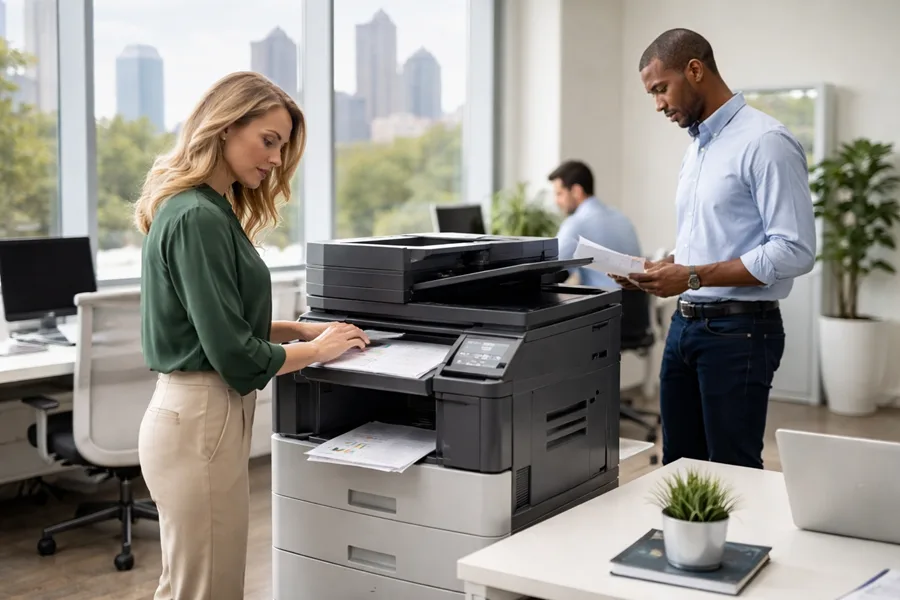
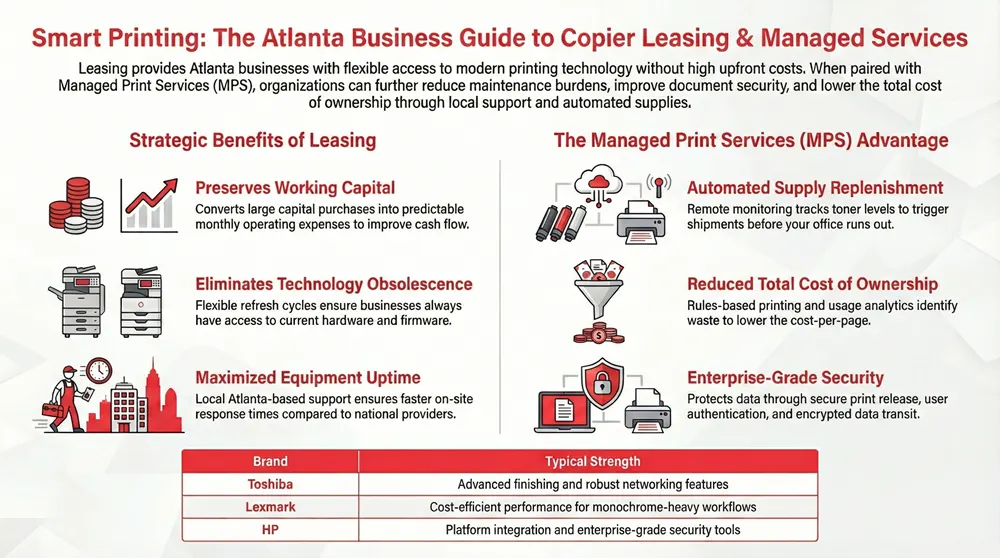
Leasing gives businesses access to modern multifunction printers and color or black-and-white copiers while turning a large capital purchase into a predictable operating expense. That preserves cash flow and simplifies budgeting. Service and supplies can be bundled into lease agreements to cut maintenance overhead and improve uptime, shifting repair risk away from internal teams. Leasing also makes it easier to schedule upgrades — new print engines, scanner modules, and firmware — so devices don’t become obsolete as needs change. Finally, working with a local provider shortens response times for onsite service, minimizing downtime and keeping busy Atlanta operations moving.
The main operational and financial benefits of leasing are:
- Lower upfront cost and steady monthly payments that preserve working capital.
- Access to current technology with upgrade paths to avoid obsolescence.
- Less internal maintenance burden when service is included.
- Faster recovery from faults and better uptime thanks to local support.
By reducing financial friction and operational complexity, leasing directly improves office efficiency and can save money over time.
If you’re ready to review local options, Automated Business Machines (ABM) offers tailored leasing and rental programs with flexible terms and local service in Atlanta. Call ABM at (706) 561-0075 to schedule a consultation or request a quote online. This example shows how the benefits above translate into practical implementation without replacing the vendor-neutral guidance here.
How Does Leasing Improve Office Efficiency and Cost Savings?
Leasing helps match devices to monthly page volumes and workflow needs so teams aren’t slowed by underpowered equipment. Centralized features — scan-to-email, cloud integration, secure print release — reduce manual handling and speed document routing. Bundled service contracts remove repeated procurement cycles for parts and toner. Predictable meter billing or all-inclusive pricing makes cost-per-page comparison straightforward and highlights opportunities to cut waste. Industry trends through 2024 show organizations reducing print-related downtime and lowering the soft costs tied to document handling.
Research consistently shows leasing tools can improve operational efficiency and overall effectiveness.
Leasing’s Role in Operational Efficiency
Leasing accounts for a significant share of new equipment transactions worldwide — supporting efficiency and flexibility for companies that rely on leased hardware.
Empirical study on managed print services pricing, J Ning, 2014
Those operational improvements often translate into lower overall printing costs and faster turnaround — which is why flexible lease terms are frequently chosen over outright purchase.
Why Choose Flexible Leasing Terms Over Buying?
Flexible lease terms let you scale a fleet up or down, add or remove devices, and upgrade to more capable MFPs as needs evolve — ideal for growing companies and hybrid workplaces. Leasing keeps equipment off the balance sheet for many organizations and can offer tax or accounting benefits depending on your policies. For short projects, event support, or satellite sites, short-term rentals deliver enterprise-grade devices without a long commitment. Flexible terms also let you tailor service inclusions — supplies, preventative maintenance, response-time guarantees — so the agreement matches your risk tolerance and budget cycles.
Customizable leases strike a balance between stability and agility, helping businesses keep print fleets aligned with changing workflows and technology requirements. The next sections cover equipment options to consider.
Which Copier and Printer Equipment Is Available for Lease or Rental in Atlanta?
Local leasing and rental catalogs usually include desktop copiers, floor-standing color multifunction printers (MFPs), high-volume black-and-white copiers, and wide-format printers — each matched to different monthly volumes and finishing needs. Devices differ by print engine capacity, scanner options, and finishers (staplers, booklet makers), so the right category depends on workflows and monthly page counts. Providers typically offer short-term rentals for events or temporary sites and long-term leases for core fleets; brand, features, and meter pricing determine the best fit. Understanding these categories helps procurement teams balance speed, cost-per-page, and paper handling when requesting quotes.
Common device categories include:
- Desktop copiers and small MFPs — compact units for low monthly volumes.
- Floor-standing color MFPs — for medium to large offices that need finishing options.
- Black-and-white high-volume copiers — built for heavy daily output.
- Wide-format printers — for posters, CAD prints, and signage.
The table below gives a quick comparison of form factor, attributes, and typical use cases to help you scan options quickly.
| Device Category / Brand | Key Attribute | Typical Use Case / Strength |
|---|---|---|
| Desktop Copier (small MFP) | Compact footprint, lower ppm | Small office, low monthly volume, easy placement |
| Floor-standing Color MFP | Color output with finishers | Reception, marketing, medium-volume departments |
| B/W High-Volume Copier | High speed, low cost-per-page | Central repro or back-office heavy printing |
| Wide-Format Printer | Large-media handling | Design shops, engineering prints, signage |
This layout shows how device form factor and capabilities align with business demands; the following subsections outline MFP features and brand choices.
If you need model-level guidance or product catalogs, local suppliers commonly stock brands like Toshiba, Lexmark, and HP and can walk you through a guided quote. Automated Business Machines (ABM) partners with these brands and can share catalogs and quote support — call ABM at (706) 561-0075 to get started.
What Types of Multifunction Printers and Copiers Do We Offer?
Multifunction printers range from compact desktop models for basic print/scan tasks to robust floor-standing color systems with high-capacity trays, duplex automatic document feeders, and advanced finishers. When evaluating MFPs, key specs include pages per minute (ppm), monthly duty cycle, network scanning options, and cloud integration for document workflows. Small-office MFPs suit teams with modest volumes and occasional color needs; larger MFPs handle high-volume scanning, secure print release, and finishing for centralized print rooms. Choosing the right accessory mix — finishers, extra paper trays, stapling/stacking modules — reduces manual handling and improves throughput.
The overview above helps you match MFP capabilities to practical tasks and leads into brand considerations for reliability and support.
Which Top Brands Are Included in Our Atlanta Leasing Solutions?
Atlanta inventories typically include trusted brands such as Toshiba, Lexmark, and HP, each with distinct advantages. Toshiba is often selected for strong finishing and robust network features; Lexmark is a solid choice for cost-effective monochrome workflows; HP provides broad platform integration and enterprise-grade security tools. Choose a brand based on priorities — color fidelity for marketing, security for regulated documents, or cost-per-page for heavy black-and-white use — and ask providers for service history and security feature details to guide procurement.
Brand selection is part of the lease negotiation; providers can present side-by-side options and cost-per-page analyses to help you decide.
| Brand | Attribute | Typical Strength |
|---|---|---|
| Toshiba | Advanced finishing and networking | Offices that need high-quality output and robust features |
| Lexmark | Cost-efficient monochrome performance | Departments with heavy black-and-white demand |
| HP | Platform integration and security | Environments needing strong security and ecosystem tools |
Use this comparison to prepare questions for demos and to evaluate quotes.
How Do Copier Lease Agreements Work in Atlanta GA?
Lease agreements outline the term, monthly payment structure, maintenance inclusions, meter billing, upgrade options, and end-of-term actions such as return, purchase, or refresh. Short-term rentals differ from long-term leases by commitment length and pricing; maintenance and parts coverage may be bundled or billed separately. Important clauses to review include on-site response times, supplies replenishment, firmware update responsibilities, and data sanitization or return conditions. Reviewing these elements before negotiation helps legal and finance teams forecast total cost and operational impact for the contract term.
Good agreements align service levels with business priorities, which matters when comparing providers and customizing terms for your office.
The table below summarizes common lease types and typical cost patterns you’ll see in the market.
| Lease Type | Term Length | Typical Monthly Cost Range | Pros / Cons |
|---|---|---|---|
| Short-term Rental | Days to 12 months | Higher monthly rate | Very flexible — ideal for events or temporary sites |
| Standard Lease | 24–60 months | Moderate monthly | Lower monthly cost; upgrade options vary |
| Service-Inclusive Lease | Varies | Includes supplies/maintenance | Predictable budget, less admin overhead |
This comparison helps you choose a structure that fits your operating tempo and budget; the following sections explain the differences in more detail.
What Are the Differences Between Short-Term Rentals and Long-Term Leases?
Short-term rentals prioritize speed and flexibility — enterprise-grade devices without long commitments but usually at a higher monthly rate and with limited customization. They suit project sites, temporary offices, event printing, or bridging equipment while permanent procurement is arranged. Long-term leases offer lower monthly payments and can include refresh or purchase options at term end, making them a better fit for steady, core office fleets. Consider expected duration, budget constraints, and how critical uptime and custom service levels are when choosing between them.
Understanding these trade-offs helps match lease type to business rhythms and prepares you to negotiate terms that support operations.
How Can Businesses Customize Lease Terms to Fit Their Needs?
Businesses can negotiate meter-included pricing, guaranteed response times, upgrade/refresh clauses, and flexible fleet scaling to align contracts with operational variability and budget cycles. Common customizations include all-inclusive supplies plans, preventative maintenance schedules, and SLAs that define technician arrival windows. Ask for clear end-of-term conditions, firmware and security update responsibilities, and data-wipe procedures on return. Bringing a checklist — monthly volume expectations, preferred brands/features, and desired service levels — speeds negotiations and yields agreements that reflect real workflows.
A concise customization checklist helps procurement teams capture critical terms during quote evaluation and keeps expectations aligned with delivery.
| Lease Element | Negotiable Attribute | Business Benefit |
|---|---|---|
| Pricing Model | Metered vs all-inclusive | More predictable budgeting |
| Service Level | Response times, remote triage | Reduced downtime |
| Upgrade Clause | Refresh intervals | Avoids obsolescence |
Automated Business Machines (ABM) can demonstrate flexible term options and customized plans with local technician coverage and tailored service inclusions. Contact ABM at (706) 561-0075 to explore term structures that match your needs.
What Managed Print Services Complement Copier Leasing in Atlanta?
Managed Print Services (MPS) pair well with leasing by consolidating fleet management, supplies replenishment, proactive maintenance, and usage reporting into a single program that reduces waste and lowers cost-per-page. MPS features such as remote monitoring, automated toner replenishment, policy-based print routing, and centralized procurement cut ad-hoc purchases and enable rule-based printing. Integrating MPS with leased devices also strengthens security through firmware management, secure print release, and user authentication. Together, leasing and MPS turn printing from a decentralized expense into a managed operational service that supports compliance and efficiency.
Academic work further explores how MPS pricing and contract structures shape provider–customer relationships.
Managed Print Services Pricing & Contracts
Managed services are a fast-growing segment that includes IT and print infrastructure management. This study examines contractual interactions between MPS providers and institutional customers using a proprietary data set.
Empirical study on managed print services pricing, J Ning, 2014
Knowing the components of MPS makes it easier to estimate ROI and identify operational improvements. The table below maps common services to business impact.
| MPS Component | Service Included | Business Benefit / Savings Estimate |
|---|---|---|
| Remote Monitoring | Device health and meter reporting | Fewer emergency repairs; better lifecycle planning |
| Supplies Management | Automated replenishment | Less stockouts and lower procurement admin |
| Print Policy Enforcement | Rules-based printing | Reduced waste and improved cost-per-page |
| Security Services | Secure print, firmware updates | Stronger compliance and data protection |
How Does Managed Print Services Optimize Printing Costs?
MPS reduces costs by centralizing supply purchases, enforcing rules that limit unnecessary color or single-sided printing, and giving managers visibility into departmental usage so devices can be reassigned or quotas adjusted. Automated ordering and consolidated billing remove transactional overhead, while usage reports reveal consolidation opportunities — for example, replacing several underused printers with one shared MFP. Over time these changes lower total cost of ownership and often deliver measurable reductions in print volume and supply spending within the first year.
Those savings can be built into lease negotiations, as noted earlier.
What Security Features Are Included in Our Managed Print Solutions?
MPS offerings typically include secure print release, device-level user authentication, encryption of data in transit, and firmware update management to close known vulnerabilities. Secure release keeps sensitive documents from piling up in output trays, while authentication ensures only authorized users collect prints. Centralized firmware oversight and scheduled updates reduce exposure to public exploits and help with regulatory audits. Specifying these security controls in both the lease and MPS agreement ensures consistent enforcement across devices.
Security should be a required line item in both lease and service terms to reduce risk and simplify compliance.
How Can Atlanta Businesses Access Copier Repair and Support Services?
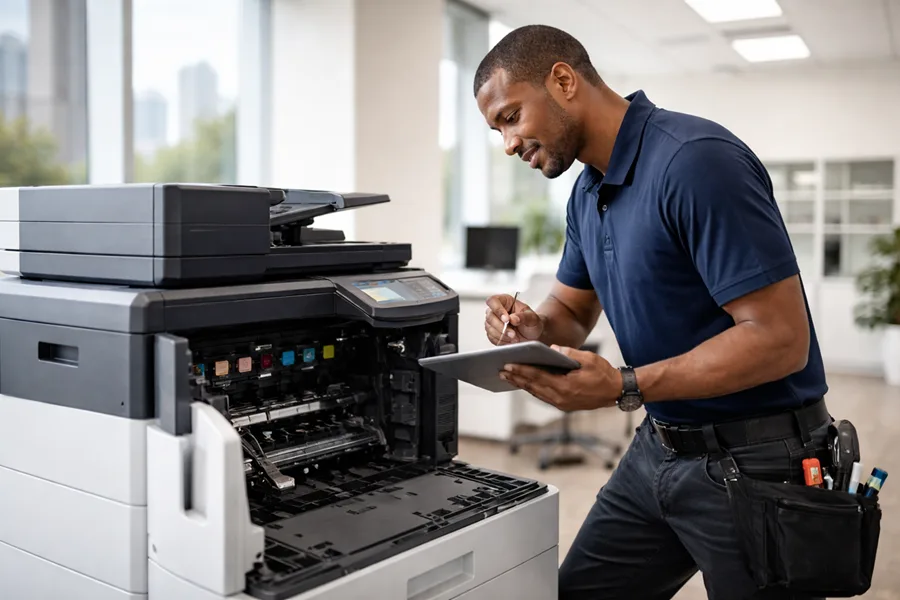
Support for leased equipment typically includes remote troubleshooting, scheduled preventive maintenance, and on-site repairs backed by SLA response windows to protect core operations. Local technician coverage and stocked parts reduce travel time and repair lead times, while priority plans offer faster escalation for mission-critical devices. Service contracts usually document escalation steps, spare-part policies, and warranty coverage so organizations understand expected uptime and recovery procedures. Choosing a provider with a proven local presence and clear SLAs helps procurement teams minimize downtime exposure.
What Emergency Repair Options Are Available for Leased Equipment?
Emergency repair options usually start with remote triage to clear software or network issues immediately, followed by on-site dispatch for hardware faults that can’t be fixed remotely. Priority plans shorten response windows and may include loaner equipment to keep operations running during repairs. Confirm the provider’s escalation matrix and how after-hours or weekend support is handled to avoid surprises. Designate a primary contact and document communication channels to speed coordination when incidents occur.
These emergency measures limit operational disruption and support continuity planning for critical departments.
How Do Maintenance Contracts Enhance Copier Reliability?
Maintenance contracts cover routine inspections, preventative part replacements, and labor for repairs — all of which lengthen device life and stabilize performance. Regular servicing catches wear items before they fail, keeps feeding mechanisms calibrated, and reduces the need for larger corrective repairs. Predictable maintenance spend simplifies budgeting and avoids emergency capital outlays. Combined with remote monitoring, maintenance programs enable data-driven schedules that maximize uptime and support fleet optimization across the lease term.
Well-structured maintenance plans therefore lower the chance of disruptive outages and improve overall equipment reliability.
Where Can Atlanta Businesses Find Cost-Effective Copier Leasing and Rental Solutions?
Start by collecting consistent quotes and comparing total cost of ownership across lease types, service inclusions, and device families — not just headline monthly rates. Evaluate providers on response times, local technician availability, parts logistics, upgrade options, and how meter billing is audited. Ask for sample metrics — expected monthly cost per department, projected cost-per-page, and examples of upgrade timing — to enable true apples-to-apples comparisons. Local providers often offer advantages in spare-parts logistics and relationship-driven account management that reduce hidden downtime costs.
Use these practical steps to get accurate, comparable quotes from local providers.
- Share monthly page volumes and typical device usage patterns for proper sizing.
- List required features and any preferred brands or device categories.
- Request sample SLAs, maintenance inclusions, and clear end-of-term options.
- Compare cost-per-page and total cost of ownership over your intended term.
Following these steps helps ensure quotes reflect real needs and supports a sound procurement decision. The next subsection shows exactly what to include in a quote request.
How to Request a Quote for Copier Leasing in Atlanta?
To get an accurate quote, provide estimated monthly black-and-white and color page volumes, required features (finishing, scanning, secure print), desired lease term or rental period, and any response-time SLAs you need. Include business hours, expected peak periods, and whether you want MPS or supplies included to make proposals comparable. Ask vendors for a sample cost-per-page calculation and clarify what triggers extra charges — for example, excessive toner use or physical damage. Supplying these details up front reduces back-and-forth and speeds procurement so equipment can be deployed sooner.
What Are the Advantages of Local Service and Personalized Support?
Local service and dedicated account management deliver faster onsite response, simpler logistics for spare parts and loaner units, and a deeper understanding of your workflows so device placement and policies are smarter. Personalized support often includes regular account reviews, tailored usage reporting, and quicker escalation for critical outages. Local providers usually maintain parts inventories nearby, cutting repair windows and reducing operational impact. These practical benefits add measurable value beyond the monthly lease price and are key when evaluating proposals.
For Atlanta businesses seeking vendor engagement, Automated Business Machines (ABM) pairs local technician coverage with consultative quote preparation — call ABM at (706) 561-0075 to request a tailored quote or discuss service options, and check their Google Business Profile for local reviews and service-area details.
This guide offers practical, vendor-neutral advice on copier leasing and rentals in Atlanta while showing how local providers like Automated Business Machines can deliver flexible terms and onsite support. By matching device categories, lease structures, and managed print services to your needs, procurement teams can optimize costs, uptime, and document security across office fleets.
Frequently Asked Questions
What factors should businesses consider when choosing between leasing and buying office equipment?
Consider cash flow, long-term technology needs, and who will handle maintenance. Leasing lowers upfront costs and provides predictable monthly payments, which helps preserve working capital. It also makes upgrades easier. Buying can be cheaper over a long ownership period but carries depreciation and maintenance responsibilities. Match the decision to your budget, growth plans, and how often you need newer features.
How can businesses ensure they select the right copier for their specific needs?
Assess monthly page volume, color versus black-and-white needs, and required features like scanning, finishing, or secure print. Think about where the device will sit and how it will fit into your workflows. Evaluate total cost of ownership — including supplies, maintenance, and energy — and ask local suppliers for model recommendations based on their experience.
What are the typical terms and conditions included in a copier lease agreement?
Typical terms cover lease length, monthly payments, whether maintenance and supplies are included, meter billing, upgrade options, and end-of-term choices (return, renew, or buyout). Review response-time commitments, supplies replenishment, firmware update responsibilities, and device return or data-sanitization requirements. Understanding these items up front helps you forecast costs and operational impacts.
What role do Managed Print Services (MPS) play in enhancing copier leasing agreements?
MPS adds centralized management: fleet oversight, automated supply replenishment, usage analytics, and policy enforcement. It reduces waste, improves security with features like secure print release and firmware management, and helps lower total cost of ownership. Integrating MPS with leased copiers turns printing into a managed service rather than a decentralized expense.
How can businesses evaluate the total cost of ownership for leased copiers?
Look beyond the lease payment to include maintenance, supplies, energy use, and any overage charges. Compare expected usage patterns and request detailed quotes that show projected cost-per-page and total costs over the lease term. This full picture lets you compare providers and make an informed choice.
What are the benefits of having local support for leased copiers?
Local support brings faster onsite repairs, shorter lead times for parts, and loaner equipment options that reduce downtime. Local teams know area workflows and can give more tailored recommendations for device placement and policy. Personalized account management and regular check-ins also help keep performance and costs on track.
Get started instantly—earn on every referral you make!
Unlock exclusive rewards with every referral—enroll now!
Apply now and receive dedicated support for affiliates!
Monetize your audience—become an affiliate partner now!
Share your unique link and cash in—join now!
Interesting points! Understanding the psychological side of games is huge. Building a solid foundation, like with a structured jiliko login register process, can really improve strategic thinking & responsible play. It’s about learning, not just luck!
Join our affiliate program today and earn generous commissions!
Refer friends, earn cash—sign up now!