
Managed Print Services (MPS) for Georgia businesses centralize printer fleet management to reduce costs, improve reliability, and tighten document security, typically delivering measurable savings and operational gains. By combining device monitoring, automatic supply replenishment, usage tracking, and proactive maintenance, MPS reduces waste and administrative burden while improving uptime and compliance. This article explains how managed print services work in Georgia, why they lower printing costs and risk, the step-by-step MPS process from assessment to continuous optimization, and how local factors in Atlanta, Columbus, and Leesburg affect solution design.
Readers will learn concrete methods to measure ROI, practical security and sustainability best practices, and where Automated Business Machines (operating as 1-800 Office Solutions) fits into the local service mix. Throughout, we use terms like managed print services georgia, printer fleet management georgia, and print security georgia to help business owners find actionable strategies for their printing environments. The guide also includes comparison tables, lists of prioritized actions, and clear next steps so IT and operations leaders can take immediate steps toward optimized, secure, and sustainable printing.
Why Should Georgia Businesses Invest in Managed Print Services?

Managed Print Services (MPS) streamline printing operations by centralizing device management, supply logistics, and usage policies to reduce cost and increase efficiency across organizations. The mechanism relies on analytics-driven device consolidation, automated supply replenishment, and policy enforcement to eliminate redundant devices and lower per-page costs, which often results in double-digit savings. Investing in MPS yields benefits in three core areas: cost reduction, productivity gains through reduced IT involvement, and improved document security that supports regulatory compliance. These effects compound as print analytics reveal hidden waste and enable targeted interventions that directly lower operating expenses. Understanding these high-level benefits sets the stage for examining specific cost drivers, security controls, and sustainability practices in the next section.
Managed Print Services deliver measurable outcomes through a combination of technology and operational change, which is why decision-makers prioritize an assessment before implementation. The assessment identifies immediate cost centers, prints per user, and devices with high service overhead, enabling a tailored optimization plan. These findings translate into concrete actions such as device consolidation, default duplex settings, and secure print release workflows that together improve ROI. With these mechanisms clarified, the next subsection details how MPS reduces printing costs and boosts return on investment.
Lion’s Mane style transition: understanding cost reduction mechanisms naturally leads to a focused look at security and compliance enhancements provided by MPS.
How Do Managed Print Services Reduce Printing Costs and Boost ROI?
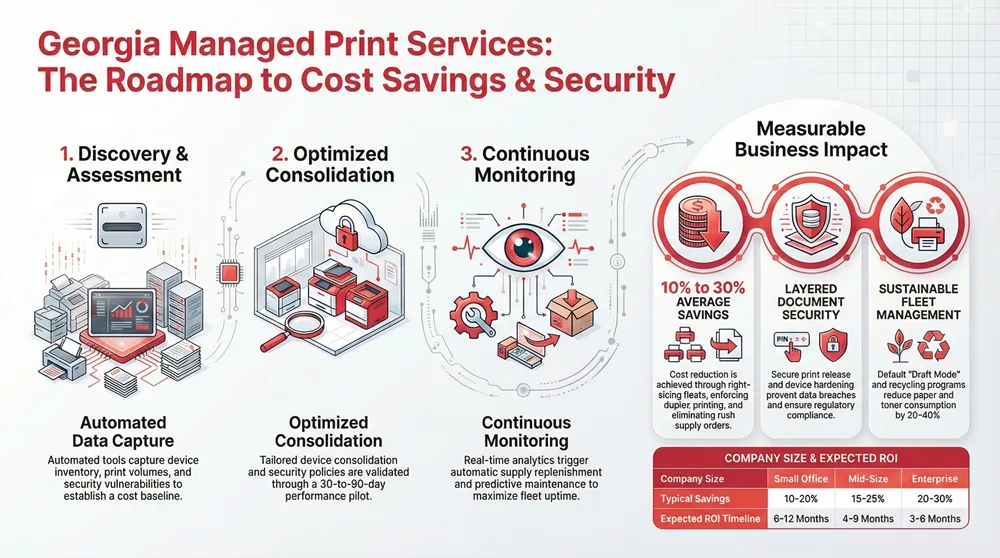
Managed Print Services reduce printing costs by consolidating underused devices, right-sizing the fleet, and negotiating supply and maintenance terms that lower the total cost of ownership. Device consolidation eliminates duplicate hardware and shifts print volume to efficient multi-function printers, while automatic supply replenishment eliminates rush toner purchases and service downtime. Usage tracking and print analytics reveal behavioral waste—such as excessive color printing or unnecessary personal prints—and enable policy changes like user quotas and default draft modes to curtail waste.
For example, a small law office in Atlanta that consolidates three legacy copiers into a single monitored fleet can cut per-page costs and reduce IT maintenance time, creating a clear ROI path within months. These cost mechanisms set the stage for improving document security and compliance, which further protects the bottom line.
In What Ways Do Managed Print Services Enhance Document Security and Compliance?
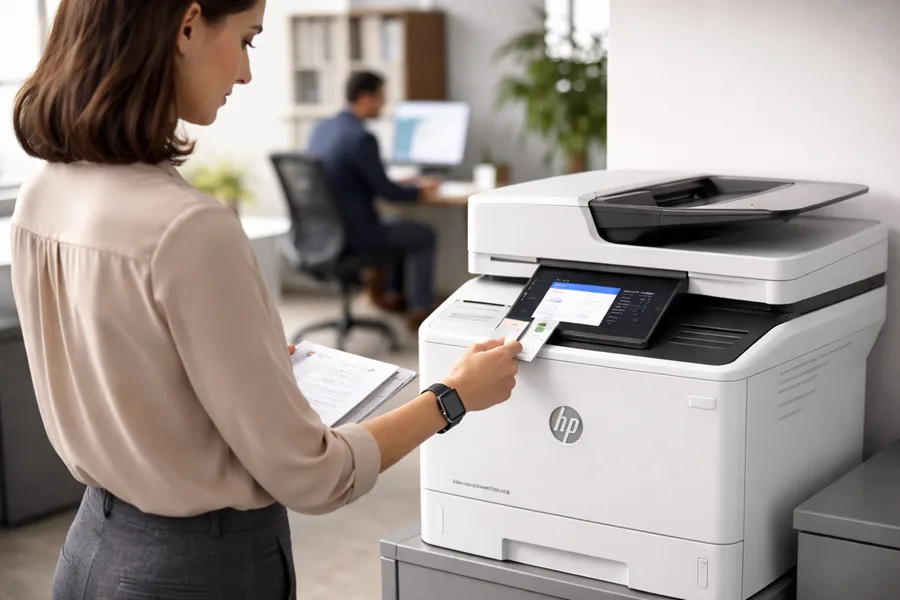
Managed Print Services strengthen document security through layered controls such as secure print release, user authentication, device hardening, and encryption of data in transit and at rest. Secure print release requires users to authenticate at the device before documents print, reducing unattended sensitive outputs and potential breaches, while authentication and audit trails provide compliance-ready logs for regulatory needs. Device hardening and timely firmware updates close known vulnerabilities, and network segmentation limits printer exposure to lateral threats in an IT environment.
Together, these controls reduce the risk of data leakage from printers and support compliance in regulated sectors like healthcare and legal services. Recognizing these security gains leads directly to a description of the full MPS process, from assessment through ongoing monitoring and reporting.
What Does the Managed Print Services Process Look Like in Georgia?
The managed print services process in Georgia follows a clear, repeatable workflow: discovery and assessment, solution design, pilot and implementation, and continuous monitoring with reporting and support. During discovery, data on device inventory, print volumes, and user behavior establish a cost baseline and security posture; solution design creates a tailored appliance and policy mix optimized for the client’s needs. A pilot validates assumptions with measurable KPIs like pages per device and service calls, and rollout includes configuration, training, and integration with document management systems. Ongoing monitoring uses analytics to enforce policies, predict maintenance, and trigger automatic supply replenishment, ensuring continuous improvement. Understanding the process steps clarifies how assessments are conducted in practice, which we describe next.
How Is a Print Environment Assessment Conducted for Georgia Businesses?
A print environment assessment collects device inventory, meter reads, supply usage, service records, and user printing patterns to build a comprehensive baseline for optimization and risk analysis. Assessments typically use automated discovery tools combined with manual audits to capture meronyms like device monitoring metrics, supply consumption records, and firmware versions, producing a prioritized list of interventions. Deliverables include a baseline cost model, security vulnerability report, and a recommended consolidation plan with expected savings and timelines, often delivered within one to two weeks for small to mid-size fleets. This structured assessment enables precise ROI calculations and informs pilot scope, which leads into the steps for fleet optimization and implementation.
What Are the Steps in Customized Print Fleet Optimization and Implementation?
Customized print fleet optimization begins with a pilot deployment to validate configuration choices, monitor usage changes, and gather real-world savings metrics before a broader rollout. Steps include selecting candidate devices for consolidation, configuring secure print release and default policies (duplex, draft mode), establishing automatic supply chains, training users, and defining KPIs to measure success. During the pilot, teams track metrics like pages per device, cost per page, and reduction in service incidents to refine the final implementation plan, with typical milestones at 30, 60, and 90 days post-deployment for ROI assessment. Proper change management and user training ensure policy adoption and maximize the efficiency gains measured in the subsequent monitoring phase.
Which Managed Print Services Solutions Are Available in Key Georgia Cities?
Managed print services in Georgia can be tailored to urban and regional needs, with providers offering remote monitoring, local technician support, and tiered service plans that reflect fleet size and response-time requirements. Larger metros like Atlanta often need high-capacity copiers, advanced security integrations, and centralized print policies, while Columbus and Leesburg clients may prioritize fast onsite response, cost-effective leasing, and small-fleet management. Service tiers typically include device monitoring, automatic supply replenishment, proactive maintenance, and print analytics dashboards that surface savings opportunities and security events. These local differentiators inform procurement decisions and deployment priorities for Georgia businesses seeking scalable, secure, and cost-efficient print solutions. After describing city-level differences, the next section highlights specific Automated Business Machines service availability across Georgia.
Intro to local services table: the table below summarizes local service focus and example benefits for key Georgia cities to help owners compare offerings quickly.
| City | Local service focus | Example benefit / response characteristic |
|---|---|---|
| Atlanta, GA | High-volume fleets, advanced security integrations | Faster scaling for large offices and robust analytics for enterprise compliance |
| Columbus, GA | Small-to-mid fleets, fast onsite support | Cost-effective leasing and quicker onsite technician response |
| Leesburg, GA | Tailored small-fleet plans, simple managed services | Lower overhead for local offices and simplified supply management |
What Managed Print Services Does Automated Business Machines Offer in Atlanta?
Automated Business Machines (operating as 1-800 Office Solutions) provides managed print services in Atlanta that emphasize device monitoring, automatic supply replenishment, usage tracking, security updates, and print fleet optimization. Their local presence in Georgia supports rapid response and technician availability, complemented by remote monitoring that reduces downtime and ensures supplies arrive before depletion. These services are designed to integrate with document management systems and support a range of paper sizes and device types to fit diverse office workflows. Mentioning these local capabilities briefly illustrates how a regional provider supports enterprise and mid-market needs without supplanting the broader discussion of MPS strategies.
How Do Columbus and Leesburg Businesses Benefit from Local MPS Providers?
Columbus and Leesburg businesses benefit from local managed print services through tailored small-fleet management, faster onsite service, and leasing options that reduce upfront capital expenditure. Local providers focus on minimizing travel time for service calls and customizing plans to reflect smaller office footprints, which often leads to better per-user cost control and simpler supply logistics. These localized advantages make it practical for small medical practices, legal offices, and branch locations to access comprehensive MPS without the complexity of enterprise contracts. Understanding local benefits prepares decision-makers to weigh city-specific tradeoffs when measuring cost and ROI, the topic of the next major section.
How Can Georgia Businesses Measure the Cost and ROI of Managed Print Services?
Measuring the cost and ROI of managed print services starts with establishing a baseline spend that captures device leases, supplies, service calls, and indirect IT management time, then comparing post-implementation metrics to quantify savings. Key metrics include total cost per page, service incidents per device, toner and paper consumption, and IT staff hours saved; print analytics and reporting provide the data required to calculate ROI. A simple ROI checklist: baseline monthly spend, identified waste reduction opportunities, projected savings percentage (commonly 10–30%), and payback timeline in months. Accurate analytics turn these metrics into actionable decisions, and the EAV table below compares typical savings and timelines by company size to clarify expectations for Georgia businesses.
| Company size | Typical savings range | Expected ROI timeline |
|---|---|---|
| Small office (1–25 users) | 10–20% | 6–12 months |
| Mid-size (25–250 users) | 15–25% | 4–9 months |
| Enterprise (250+ users) | 20–30% | 3–6 months |
What Are Typical Savings Percentages for Georgia Companies Using MPS?
Typical savings for Georgia companies using managed print services range from about 10% to 30%, with variability driven by baseline inefficiencies, fleet age, and existing supply contracts. Companies with numerous unmanaged devices or frequent out-of-warranty repair needs typically see the higher end of savings through consolidation and proactive maintenance, while those with optimized fleets already may see more modest gains focused on security and productivity. Industry type matters as well: law firms and healthcare offices often gain additional value from compliance and audit capabilities beyond pure cost savings. These typical ranges help set realistic expectations and inform the pilot metrics used during implementation.
Intro to analytics list: print analytics play a pivotal role in turning data into savings by highlighting trends and enabling targeted interventions.
- Real-time dashboards surface print hotspots and device utilization trends within hours.
- Alerts notify IT or service teams of low-supply or error conditions before user impact occurs.
- Trend analysis identifies persistent overuse or waste patterns that inform policy changes.
How Does Print Analytics Support Cost Reduction and Efficiency?
Print analytics support cost reduction by presenting device-level usage, user behavior, and supply consumption in actionable dashboards that enable targeted interventions like device consolidation and policy enforcement. Analytics produce specific triggers—such as high color print rates or frequent single-page color jobs—that can be addressed through user quotas, default settings, or retraining, translating directly to lower supply costs. Predictive maintenance indicators also reduce downtime and emergency service costs by scheduling work before failures occur, which improves uptime and reduces ad hoc support expenses.
Together, analytics, usage policies, and supply automation create a feedback loop that continually reduces cost per page and supports measurable ROI. For organizations ready to act, Automated Business Machines can provide a free print assessment to quantify baseline spend and projected savings, with 24/7 support and local service coverage in Georgia.
Indeed, the strategic use of data analytics is increasingly recognized as fundamental for optimizing print production and achieving significant business efficiencies.
Data Analytics for Optimized Print Production
Data analytics, following data collection, storage and handling, has become a crucial component of any business management system as an integral tool for creating strategies in all major organizations. The printing industry -of course- is not an exception to this rule. Analytic tools are embedded in all major MIS (Management Information Systems) and data are collected throughout the production from prepres
The importance of data analysis in the modern era of print production
What Are the Best Practices for Secure and Sustainable Print Management in Georgia?
Secure and sustainable print management combines technical controls with user policies and procurement choices to reduce data risk and environmental footprint while lowering operating costs. Core practices include secure print release and user authentication to prevent unattended sensitive outputs, regular firmware updates and device hardening to close vulnerabilities, and default duplex and draft settings to reduce paper and toner use. Sustainable strategies such as device consolidation and toner recycling reduce waste and purchasing frequency while offering cost benefits, and reporting mechanisms measure environmental impact alongside financial savings. Implementing these practices requires cross-functional coordination between IT, procurement, and operations to ensure policy adherence and measurable outcomes, which the table below maps to specific security/sustainability benefits.
| Practice | Targeted outcome | Measurable impact |
|---|---|---|
| Secure Print Release | Prevent unattended sensitive prints | Fewer data exposure incidents |
| Firmware patching and hardening | Reduce device vulnerabilities | Lowered breach risk and compliance gaps |
| Duplex default and draft mode | Reduce paper/ink consumption | 20–40% fewer sheets printed |
| Recycling and supply reuse programs | Reduce landfill and procurement cost | Less waste and lower supply spend |
This mapping clarifies how each practice contributes to risk reduction and sustainability goals, and the following subsection explains security measures that specifically prevent data breaches.
How Do Managed Print Services Improve Print Security and Prevent Data Breaches?
Managed Print Services improve security by enforcing authentication, encrypting data channels, maintaining audit logs, and applying device-level hardening to reduce exploit surface area. Authentication and secure-release workflows ensure only authorized users retrieve sensitive documents, while encryption of print jobs prevents interception during transmission across a network. Audit trails provide forensic evidence for compliance and incident response, and firmware updates close known attack vectors to prevent exploitation. Combined, these measures create layered defenses that significantly reduce the probability of printer-related data breaches and strengthen an organization’s broader cybersecurity posture. These security controls naturally align with sustainability practices, which we discuss next.
What Sustainable Printing Practices Can Georgia Businesses Implement?
Sustainable printing practices prioritize reducing paper and toner use, selecting eco-friendly supplies, and extending device lifecycles through consolidation and maintenance to minimize environmental impact. Practical steps include setting default duplex printing, enabling draft modes for internal documents, implementing print quotas to curb excessive use, and participating in cartridge recycling programs to reduce landfill contribution. Device consolidation reduces energy consumption and simplifies lifecycle management, while procurement choices for energy-efficient models lower long-term operational emissions. Together, these strategies reduce both environmental footprint and operating costs, reinforcing the business case for integrated secure and sustainable print management. These best practices lead naturally to selecting a managed print provider, where local expertise and service scope matter.
Why Choose Automated Business Machines for Managed Print Services in Georgia?
Automated Business Machines (operating as 1-800 Office Solutions) offers a local Georgia presence with managed print services that emphasize cost-efficient and professional print management, device monitoring, automatic supply replenishment, usage tracking, security updates, and print fleet optimization. The company’s stated UVPs include comprehensive solutions across monitoring, supplies, analytics, and support, with 24/7 customer support and the ability to handle various paper sizes for diverse workflows. These capabilities complement the technical and process-focused strategies discussed earlier by providing regional support in Atlanta, Columbus, and Leesburg and by aligning service delivery with measurable KPIs. Below are practical reasons organizations choose a local partner for MPS.
- Local technicians reduce onsite response times for hardware issues and repairs.
- Remote monitoring and automatic supplies minimize downtime and avoid emergency purchases.
- 24/7 support and comprehensive service scope ensure continuity and consistent SLA performance.
This list emphasizes how combining technical MPS capabilities with local service delivery produces operational resilience and measurable savings, leading into a brief look at ABM’s local support model.
What Local Expertise and Support Does ABM Provide Across Georgia?
Automated Business Machines provides local support modes that include onsite technicians, remote monitoring, and supply management tailored to Georgia clients, with city coverage in Atlanta, Columbus, and Leesburg. The local model pairs remote analytics-driven monitoring with technicians who can respond for repairs and configuration changes, reducing downtime and aligning service levels with client expectations. Remote interventions resolve many issues before they impact users, while local presence handles hardware and advanced configuration needs that require onsite attention. This hybrid support approach enhances continuity and operational predictability, and the next subsection explains how technology partnerships further strengthen MPS delivery.How Do ABM’s Technology Partnerships Enhance MPS Solutions?
ABM’s technology partnerships expand device choice, improve parts availability, and enable certified integrations for print security and analytics, ensuring solution compatibility and robust SLAs. Partner relationships allow faster access to replacement parts, validated integrations with document management systems, and vendor-supported firmware management for secure device operation. These partnerships also support multi-vendor environments, giving clients flexibility in hardware selection while maintaining centralized monitoring and policy enforcement. By combining local expertise with partner-backed technology, providers can deliver reliable, secure, and scalable managed print services that align with the measurement and sustainability practices covered earlier.