
AI Overview:
Copier leasing helps Georgia businesses modernize office equipment without large upfront costs, improving cash flow, budgeting, and operational flexibility. Through real-world success stories from Atlanta and across the state, the blog shows how fixed monthly payments, included maintenance, upgrade options, and managed print services reduce downtime, lower total cost of ownership, and ease IT and administrative burdens. It also provides a clear lease-vs-buy comparison, highlights customer feedback on local service, and outlines a simple path to start a copier lease with Automated Business Machines (ABM).
Copier Leasing Success Stories: How Georgia Businesses Benefit from Flexible Office Equipment Leasing
Copier leasing gives Georgia organizations steady access to current office equipment without the large upfront cost of purchase. That preserves cash flow, simplifies budgeting, and makes it easier to refresh technology on a predictable schedule. This guide walks through how leasing works, measurable benefits seen by companies in Atlanta, Columbus, Augusta, and Savannah, and practical steps to compare lease options for your team.
You’ll see why fixed monthly fees, included service, and upgrade flexibility lower total cost of ownership and keep devices working when your team needs them most. Inside: core leasing benefits, anonymized case-study highlights with before/after metrics, an objective lease‑versus‑buy comparison that notes tax and accounting points, customer feedback about local service and managed print integration, and a straightforward path to start a lease with Automated Business Machines (ABM). Throughout, useful search phrases like copier leasing case studies, managed print services ROI, lease vs buy copier, and copier leasing Atlanta are integrated into clear, actionable guidance that helps procurement, IT, and finance leaders decide with confidence.
What Are the Key Benefits of Copier Leasing for Georgia Businesses?
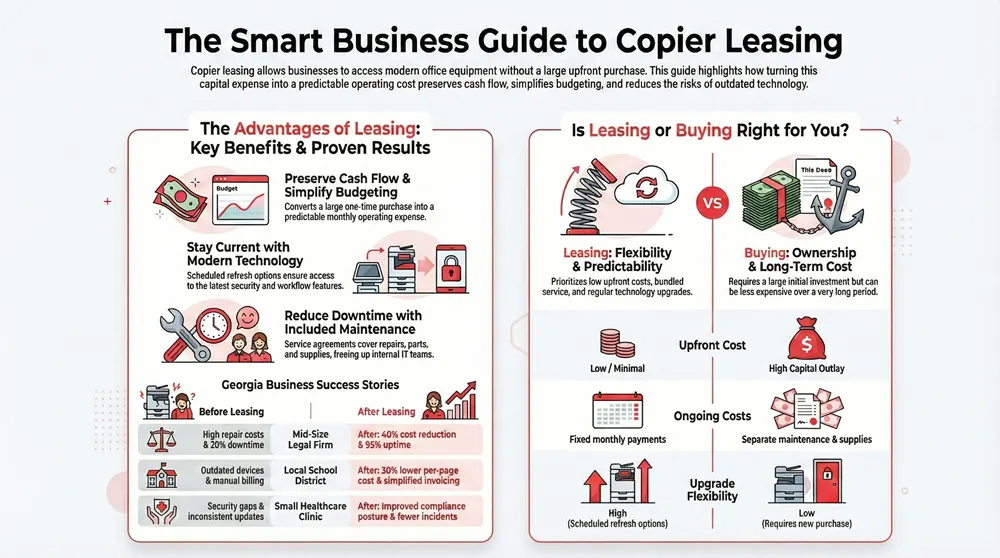
Leasing copiers delivers financial flexibility, up‑to‑date hardware, and bundled operational support that together lower risk and boost productivity. Turning a large capital purchase into a predictable operating expense preserves working capital and makes budgeting simpler, while giving you access to modern features such as mobile/cloud printing and stronger device security. Maintenance and service level agreements (SLAs) cut downtime and free internal IT from routine repairs. For small and mid‑size organizations, leasing creates a straightforward way to scale imaging resources without the risk of obsolete equipment.
Leasing packages concentrate several practical advantages into a repeatable payment model and easier lifecycle management. The short list below captures the core benefits we’ll quantify later with examples.
Top advantages of copier leasing:
- Predictable monthly payments: Replaces a large CAPEX hit with regular operating expenses that simplify budgeting.
- Technology refresh: Regular upgrade options keep devices current with security and workflow improvements.
- Included maintenance and consumables: Lowers surprise repair costs and shortens downtime.
- Scalability: Adjust your fleet up or down as headcount and print volumes change without long-term asset headaches.
- Tax and accounting flexibility: Lease payments frequently align with operating‑expense treatment — consult your advisor for specifics.
Together, these benefits reduce operational risk and make planning easier for procurement and IT teams.
Intro to the benefits table: The table below pairs benefit categories with the measurable outcomes that matter to finance, operations, and IT.
| Benefit Category | Typical Attribute | Practical Value |
|---|---|---|
| Financial Flexibility | Monthly fixed payments | Preserves cash flow and simplifies budgeting |
| Technology Upgrades | Scheduled refresh cadence | Reduces obsolescence and improves security features |
| Maintenance & Repair | SLA-backed service | Decreases average downtime and reactive repair spend |
| Scalability | Flexible fleet adjustments | Aligns equipment with headcount and volume changes |
| Cost Predictability | Consolidated billing | Simplifies invoice processing and cost allocation |
This side‑by‑side view shows how leasing maps operational attributes to measurable business results that procurement and finance teams can act on.
How Does Copier Leasing Improve Financial Flexibility and Cash Flow?
Leasing turns a one‑time capital purchase into a predictable operating cost, helping companies preserve cash and maintain borrowing capacity. Monthly lease payments smooth expenses across the contract term, making forecasting and budgeting easier for finance teams. Service‑inclusive packages also reduce the risk of unexpected repair spikes that can upset monthly forecasts. Instead of spending tens of thousands up front to buy a fleet, a business can match monthly payments to usage and revenue cycles — which also simplifies side‑by‑side ROI comparisons between proposals.
Accounting and tax treatment depend on lease structure, so consult your accountant for precise guidance. When payments qualify as operating expenses, leasing can improve near‑term cash flow and reporting metrics that matter to executives and lenders.
What Technology Upgrades and Maintenance Are Included in Copier Lease Agreements?
Typical lease agreements include scheduled maintenance, parts and labor, firmware and security updates, and options for periodic equipment refreshes. Maintenance language usually spells out SLA response times and preventative visits; upgrade clauses commonly specify a refresh cadence (often every 3–5 years) so you keep access to cloud integrations and enhanced security. Those inclusions cut downtime and reduce the internal burden of managing supplies and repairs.
Pooled with managed print services, leases often include centralized monitoring and automatic supply replenishment to prevent interruptions. Knowing what a proposal includes helps IT teams compare offers and set clear service expectations.
Which Georgia Businesses Have Achieved Success with Copier Leasing?
Across Georgia, companies in sectors like legal, education, and professional services have used copier leasing to ease cash‑flow pressure, modernize workflows, and reduce IT workload — while delivering measurable improvements. Case studies show that replacing aging fleets with leased multifunction devices and managed print services raised uptime, lowered per‑page costs, and freed staff time for higher‑value work. These examples reveal how leasing translates into concrete operational gains for local organizations.
Below is a quick, scannable table of anonymized case highlights with before/after metrics you can use to estimate likely outcomes for similar operations.
| Client Industry | Challenge / Metric | ABM Solution | Result / Metric |
|---|---|---|---|
| Legal firm (mid-size) | High repair costs; 20% downtime | Lease MFDs + managed print service | 40% reduction in repair costs; 95% uptime |
| Local school district | Outdated devices; manual billing | Fleet refresh + consolidated billing | 30% lower per-page cost; simplified invoicing |
| Small healthcare clinic | Security gaps; inconsistent updates | Leased secure copiers with firmware updates | Improved compliance posture; fewer incidents |
These snapshots show how targeted leasing programs address specific pain points and produce measurable results for Georgia organizations.
What Challenges Did These Businesses Face Before Leasing Copiers?
Before leasing, many organizations wrestled with unpredictable repair bills, aging machines lacking current security features, and slow workflows that reduced staff productivity. Large upfront purchase costs delayed refresh cycles, leaving teams to work with devices beyond their useful life. Managing billing and consumables across multiple vendors often meant extra administrative work. Those operational issues translated into direct costs and lost productive time.
Recognizing these common problems makes it clear how structured leasing programs — paired with managed print services and responsive local technicians — delivered measurable improvements for the client profiles above.
How Did ABM’s Copier Leasing Solutions Deliver Measurable Results?
When ABM combined flexible leases with managed print services and defined SLAs, customers saw clear gains in cost control and device availability. For the legal firm, ABM bundled a financeable lease with proactive maintenance to cut reactive repair costs and restore uptime for attorneys. The school district benefited from fleet optimization and consolidated billing that reduced per‑page costs and administrative overhead. ABM’s local service network and partnerships with major equipment brands helped deliver fast response times and consistent performance.
Those outcomes illustrate how a local provider’s mix of leasing terms, maintenance, and managed‑print integration can unlock operational and financial benefits for Georgia businesses.
How Does Copier Leasing Compare to Buying for Georgia Companies?
Leasing and buying are two different ways to acquire office equipment. Buying requires a larger upfront investment and assumes long‑term ownership; leasing prioritizes flexibility, predictable payments, and often includes service. Financially, buying can be less expensive over a very long retention period, but it raises obsolescence risk and immediate cash outlays. Leasing reduces that risk with scheduled refreshes and moves costs into operating budgets. Operationally, many leases include maintenance and monitoring that buyers must arrange separately.
The table below compares core financial, operational, and tax considerations to help guide your decision.
| Option | Upfront Cost | Ongoing Costs | Tax Treatment | Upgrade Flexibility |
|---|---|---|---|---|
| Lease | Low / minimal | Fixed monthly payments; maintenance often included | Payments frequently treated as operating expenses (consult advisor) | High — scheduled refresh options available |
| Buy | High capital outlay | Lower monthly payments but separate maintenance and consumables | Depreciation and potential Section 179 considerations (consult advisor) | Low — requires additional capital to upgrade |
| Hybrid (lease-to-own) | Moderate | Balanced payments; possible buyout | Mixed treatment depending on structure | Moderate — options to purchase at term end |
This comparison helps finance and procurement teams weigh total cost of ownership, tax implications, and upgrade risk when choosing the right path.
What Are the Financial and Tax Advantages of Leasing vs. Buying?
Leasing can offer accounting and tax benefits by letting companies treat payments as operating expenses, which may improve reported EBITDA and preserve capital for strategic priorities. Lower upfront costs support better cash‑flow management and free working capital for growth. That said, tax treatment depends on lease structure and jurisdiction — always consult your tax advisor to understand depreciation, deductibility, and balance‑sheet impacts. Side‑by‑side examples that compare monthly lease payments with loan amortization can show how leasing eases near‑term cash burden even if lifetime costs are similar.
Leasing vs. Buying: Understanding Tax Treatment and Risks
Moreover, careful sorting out of the relevant risks at this point will enable us to avoid some otherwise unavoidable distractions in later sections dealing with the tax treatment of leases.
Leasing, buying, and the cost of capital services, 1976
With that financial perspective, teams can choose lease terms, end‑of‑term options, and upgrade clauses that match growth plans.
How Flexible Are Copier Lease Terms for Business Growth and Upgrades?
Lease agreements typically offer a range of term lengths — short options for transitional projects and multi‑year terms for steady operations — along with trade‑in or upgrade clauses to support growth. Common terms include 24, 36, and 60 months, with refresh or trade options at defined intervals. Early‑exit and scale‑up provisions differ by provider but can often be negotiated to match expected expansion or contraction. That flexibility reduces obsolescence risk and keeps equipment aligned with business needs.
Understanding term options and negotiating clear upgrade paths lets IT and procurement teams align device lifecycles with technology roadmaps and budget cycles.
What Do Atlanta and Other Georgia Customers Say About Their Copier Leasing Experience?
Local customers consistently call out fast service response, skilled technicians, and the relief of having maintenance bundled into leases — factors that together boost uptime and user satisfaction. Reviews also note the convenience of consolidated billing and simpler vendor management after moving to leased fleets with managed print services. These themes recur across feedback from Atlanta, Columbus, Augusta, and Savannah, showing common service expectations for Georgia organizations.
Key points from customer feedback that matter to procurement and IT:
- Fast on‑site response times from local technicians, which reduce downtime and workflow interruptions.
- Knowledgeable support staff who simplify troubleshooting and end‑user training.
- Consolidated billing and reporting that make cost allocation and vendor management easier.
Those recurring themes explain why many Georgia organizations pair leasing with managed print or IT services to amplify results.
Which Atlanta Copier Lease Reviews Highlight ABM’s Customer Service?
Atlanta‑area reviews often highlight quick on‑site support and technicians who resolve issues efficiently, which improves uptime and user confidence. Customers report that fast ticket resolution limits disruptions to daily work and reduces productivity losses from printer outages. Reliable local support plus centralized reporting gives administrative teams clearer visibility into usage and cost trends.
These service advantages make it easier to justify leasing as a path to dependable local support and simpler operations.
How Do Managed Print Services Complement Copier Leasing Success?
Managed Print Services (MPS) extend leasing benefits by centralizing fleet oversight, optimizing device placement, and consolidating supplies and billing. MPS provides usage analytics, automated consumables replenishment, and policy‑driven controls that reduce waste and tighten security. Paired with leasing, MPS ensures devices match workflow demands and that support is proactive rather than reactive.
Combined, leasing and MPS deliver stronger cost control, improved security posture, and simplified administration for organizations seeking a complete print strategy.
How Can Georgia Businesses Get Started with Copier Leasing from ABM?
Starting a copier lease is a short, structured process that moves from assessment to installation so you can compare options and timelines clearly. Automated Business Machines (ABM) provides local assessments and leasing packages tailored to Georgia businesses, pairing trusted equipment with maintenance‑included plans and flexible financing. The numbered steps below outline the typical path most customers follow to secure a lease and begin realizing benefits quickly.
- Request an initial consultation to review your current fleet, usage volumes, and workflow priorities.
- Schedule an on‑site or remote assessment to capture meter reads, identify bottlenecks, and model total costs.
- Review a tailored proposal that compares lease terms, service levels, and upgrade options side by side.
- Finalize the lease agreement, pick installation dates, and plan user training and migration.
Following these steps produces a clear installation timeline and a predictable monthly cost structure, helping teams move from legacy equipment to a managed leased fleet with minimal disruption.
Intro to options table: The table below outlines typical leasing packages and which business profiles they suit, to help you match needs to terms.
| Leasing Option | Typical Term Length | Service Level | Best For |
|---|---|---|---|
| Short-term lease | 12–24 months | Basic maintenance | Short projects, temporary sites |
| Standard lease | 36–48 months | Maintenance included + SLA | Small to mid-size offices |
| Long-term lease with refresh | 60 months with refresh clause | Premium SLA + upgrade path | Large operations needing stability |
This options matrix helps decision‑makers pick lease terms that align with budget cycles and growth plans.
What Are the Steps to Request a Quote or Consultation?
To request a quote, start with a short discovery that records your fleet size, primary use cases, and pain points so proposals reflect real usage. Next, an assessment — either remote meter reads or an on‑site evaluation — captures exact page volumes and device inventory. ABM or another provider will then produce a comparative proposal showing monthly lease payments, included services, and upgrade options. You can typically expect a proposal within days of the assessment, with installation scheduled once the contract is approved.
Following this process delivers transparent comparisons and helps procurement teams estimate savings and service improvements before committing.
Which Flexible Leasing Options Does ABM Offer to Suit Different Business Needs?
ABM’s leasing portfolio includes short‑term leases for transitional needs, standard multi‑year leases with maintenance included, and long‑term plans with scheduled refresh clauses that support technology upgrades. Maintenance tiers vary by SLA so you can choose faster on‑site response or more economical remote support. Trade‑in and upgrade programs are structured to match growth profiles, helping small offices, mid‑size companies, and high‑volume sites find the right balance of cost and capability.
- Short‑term leases for temporary capacity or project‑based deployments.
- Standard terms with included maintenance for predictable operations.
- Long‑term agreements with built‑in refresh options for large or security‑sensitive operations.
Selecting the right package helps businesses control costs while keeping access to current copier technology and responsive local service.
This guide has shown how copier leasing drives measurable benefits, highlighted Georgia success stories with concrete metrics, compared leasing and buying in practical terms, summarized customer feedback on service, and provided a clear path to start leasing with an experienced local provider. Use the tables and steps above to evaluate leases versus purchases, estimate ROI, and choose a procurement path that improves uptime, reduces administrative overhead, and supports predictable budgeting.
Frequently Asked Questions
What types of businesses benefit most from copier leasing in Georgia?
Leasing is especially useful for small and mid‑sized organizations across legal, education, healthcare, and professional services — sectors that often balance cash‑flow constraints with a need for modern equipment. Leasing lets them access quality devices without a large upfront investment, freeing funds for other priorities. Businesses with seasonal or unpredictable demand also benefit from the scalability leasing provides.
How can businesses assess their copier leasing needs?
Start by measuring current print and copy volumes, documenting workflows, and noting device performance issues. Identify pain points like frequent downtime or rising maintenance costs. An on‑site assessment from a leasing provider will validate meter reads, reveal bottlenecks, and help tailor a solution that fits usage and budget. That fact‑based approach ensures lease proposals reflect real needs and expected outcomes.
What are the common misconceptions about copier leasing?
A common myth is that leasing is always more expensive than buying. While leasing involves ongoing payments, it often includes service and upgrades that reduce total costs over time. Another misconception is that leasing locks you into outdated tech — most leases include refresh options so you stay current. Finally, leasing is sometimes seen as inflexible, but many agreements allow adjustments to match changing business needs.
How do businesses ensure they choose the right leasing provider?
Look for providers with a strong local presence, demonstrable service levels, and positive customer feedback. Compare lease terms, maintenance coverage, upgrade options, and SLA response times. Ask for references and case studies in your industry. Clear communication about expectations and a transparent proposal will help you pick a partner who delivers consistent local support.
What should businesses consider when negotiating lease terms?
Negotiate lease length, included services, upgrade options, and SLA response times. Clarify responsibilities for maintenance and consumables, and ask about early‑exit or scale‑up provisions. Review the total cost of ownership, including any fees or potential buyouts at term end, so the agreement aligns with your financial and operational goals.
Can copier leasing improve environmental sustainability for businesses?
Yes. Leasing providers often offer energy‑efficient models and handle responsible disposal or recycling of old equipment. Regular refreshes mean you move to more efficient machines over time, and managed print services can cut waste through usage analytics and policy controls. These practices lower energy use and printing waste, supporting sustainability goals and appealing to eco‑conscious stakeholders.