
AI Overview:
The size of a legal pad most commonly refers to 8.5 x 14 inches (216 x 356 mm), but the term “legal pad” actually comes from its signature 1-1/4″ left margin, not its dimensions. This guide explains the three main pad sizes—Junior (5 x 8), Letter (8.5 x 11), and Legal (8.5 x 14)—and how each fits different workflows, from office use to legal work and field notes. It also breaks down key features like ruling styles, paper colors, bindings, perforations, eco-friendly options, and practical tips for choosing the right pad based on writing style, portability, filing systems, and professional needs. Whether you’re taking quick notes or drafting detailed documents, understanding the size of legal pad options helps improve productivity, comfort, and organization.
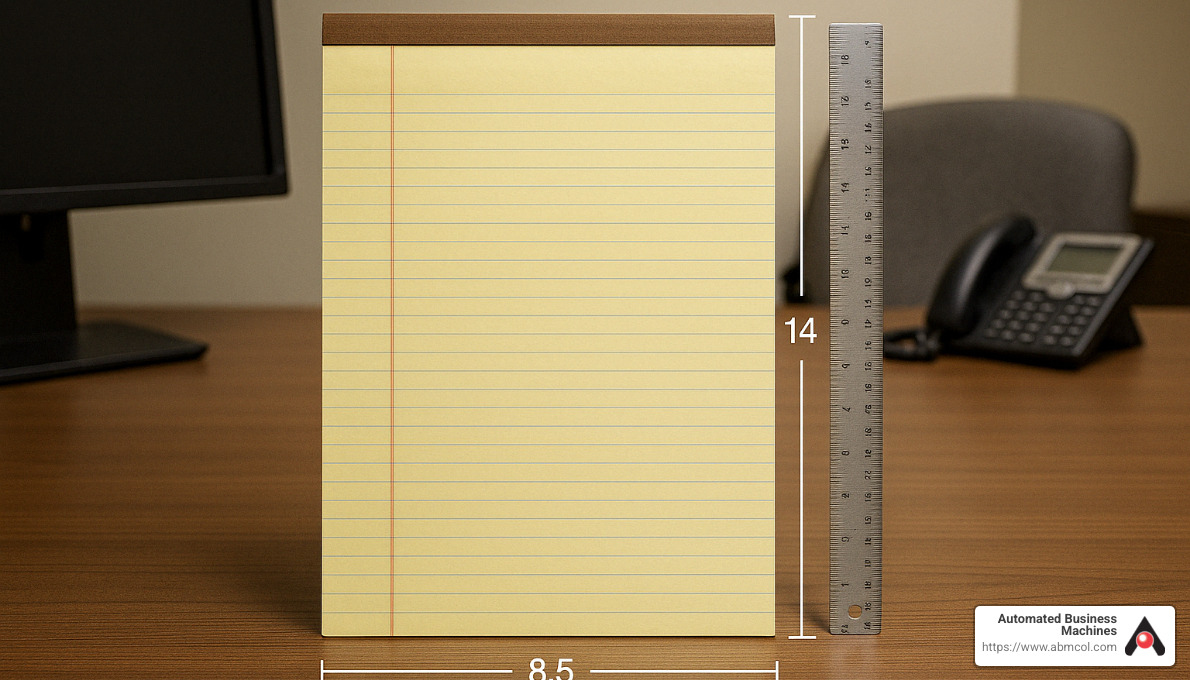
The size of legal pad typically refers to a pad measuring 8.5 x 14 inches (216 x 356 mm). This is the standard dimension used commonly in professional and legal settings.
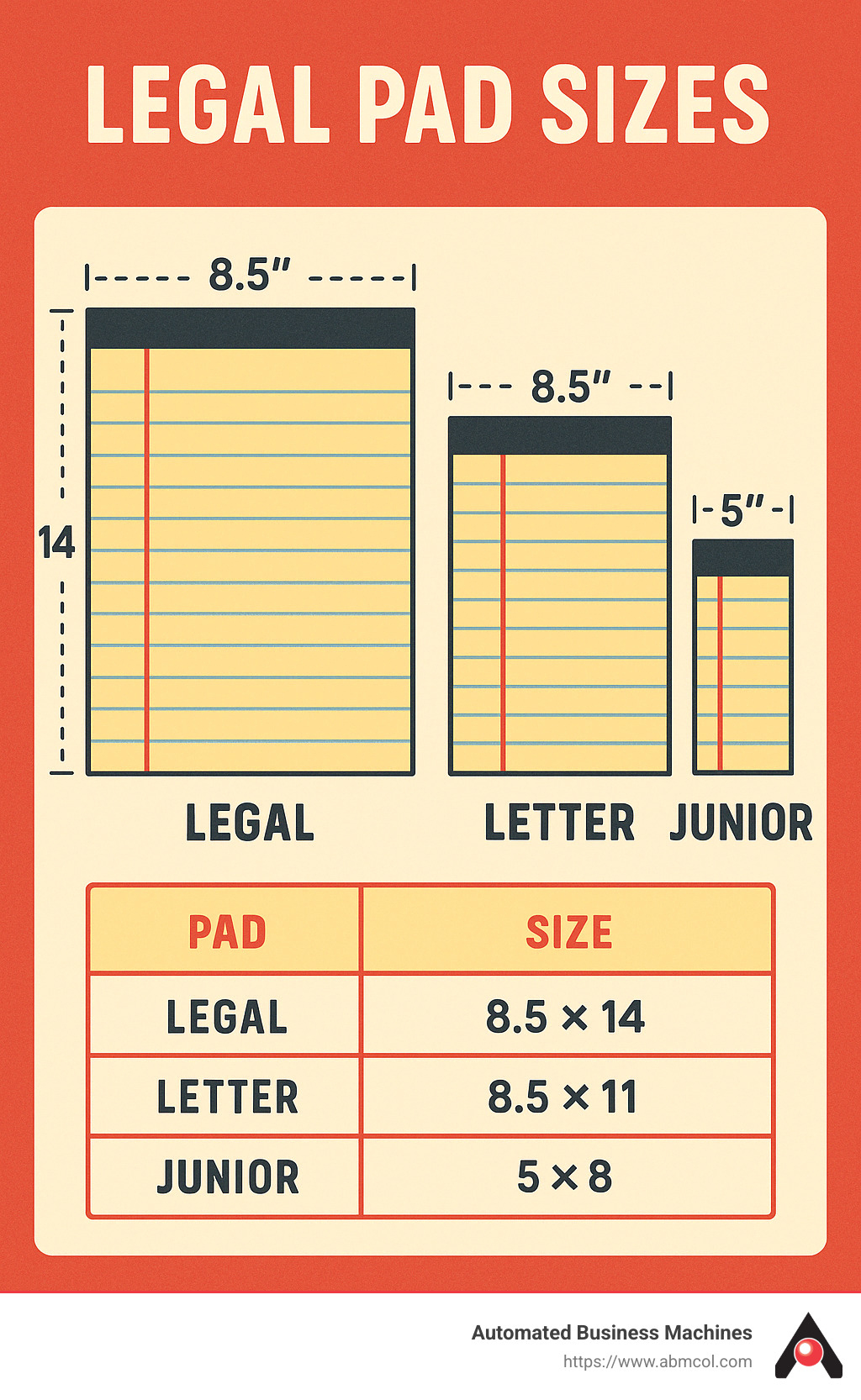
Here’s a quick snapshot of standard legal pad sizes:
| Pad Type | Dimensions (inches) | Dimensions (mm) |
|---|---|---|
| Legal | 8.5 x 14 inches | 216 x 356 mm |
| Letter | 8.5 x 11 inches | 216 x 279 mm |
| Junior | 5 x 8 inches | 127 x 203 mm |
Legal pads are popular tools for note-taking, organizing thoughts, and preparing official documents. Their defining characteristic is a vertical line placed 1-1/4″ from the left edge, giving space for annotations or numbered lists.
In the sections below, we’ll dive deeper into variations, features, and practical tips to help you pick the perfect pad for your needs.
Standard Dimensions: What Is the Size of a Legal Pad?
When someone mentions a legal pad, most of us immediately picture that classic yellow notepad. But here’s a fun fact: the term “legal pad” doesn’t actually refer to the pad’s size at all. Instead, it’s all about that distinctive vertical margin on the left side!
Still, when we say size of legal pad, we’re usually talking about pads that use standard legal paper dimensions. Officially, legal-sized paper measures 8.5 x 14 inches (216 x 356 mm). To visualize, that’s a bit longer than standard printer paper—perfect when you need extra room for detailed notes, lengthy lists, or official documents. In total, this size creates about 0.83 ft² (or roughly 0.077 m²) of writing space.
Curious about what that means in digital terms? For designers or anyone printing professional materials, legal paper at a print-ready resolution of 300 DPI equals approximately 2551 x 4205 pixels. At Automated Business Machines, we make sure our multifunction printers are precisely calibrated for exactly these dimensions, ensuring flawless prints every time.
The Significance of the 1-1/4″ Left Margin
Believe it or not, the defining feature of a true legal pad isn’t its size or even its signature yellow color—it’s the margin. Yes, really!
As the rule clearly states:
“The only requirement for a pad of writing paper to qualify as a ‘legal pad’ is that the paper must have a 1-1/4″ vertical line placed from the left edge of the page.”
This margin isn’t just for looks—it serves a real practical purpose. It gives you space for quick notes and annotations, a tidy area for numbering items, and a neat starting point so your notes stay organized.
Traditionally, true legal pads come in yellow (“canary”) with blue horizontal lines and that unmistakable red vertical margin. The soft yellow shade isn’t just random—it was chosen because it’s easier on the eyes during long writing sessions. (Your eyes say thank you!)
Interestingly, that famous 1-1/4″ margin is standard across all legal pads, regardless of actual paper size. Even a smaller junior-sized pad still proudly sports this margin, keeping the “legal” tradition alive.
Understanding the Size of Legal Pad Variations
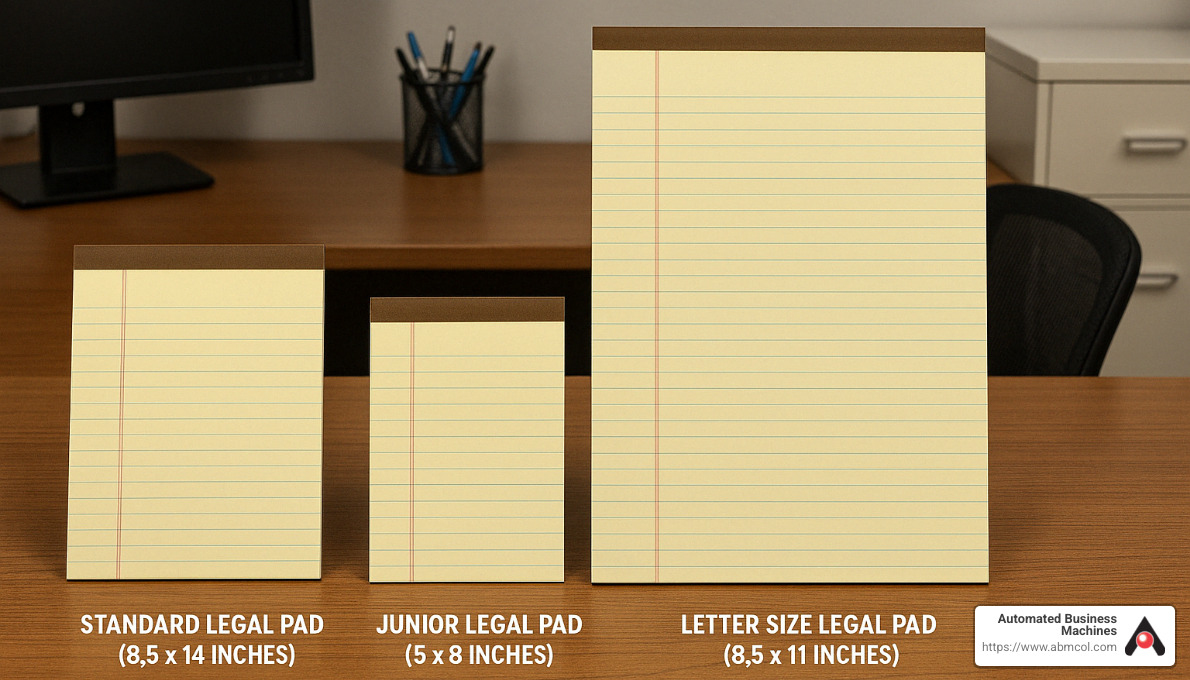
While the classic size of legal pad is that trusty 8.5 x 14 inches, life often requires a bit of variety. Thankfully, legal pads come in several handy sizes to suit different tasks and lifestyles.
First, there’s the Junior Legal Pad (5 x 8 inches). Think of this as the little sibling of your standard legal pad—perfectly portable and ideal when you’re on the go. Easily tossed into a briefcase or bag, it’s beloved by professionals who need to jot quick notes during meetings or fieldwork sessions.
Next is the Letter Size Legal Pad (8.5 x 11 inches). This size matches standard letter-sized paper, making it a favorite for daily office life. It’s just the right fit for regular binders, folders, and filing systems—keeping your pages neat and organized without hassle.
Lastly, there’s the unique Government Legal size (8.5 x 13 inches). Slightly shorter than standard legal size, this one often pops up in official government documents and specialized professional settings.
These pads all share the essential legal pad hallmark: that distinctive 1-1/4″ margin. So no matter which size suits your needs best, you’ll enjoy the same practical layout and classic appeal.
Whether you’re jotting quick reminders or drafting complex legal documents, knowing the size of legal pad options available makes it easier to choose the perfect match for your workflow.
Legal Size vs Letter Size: Understanding the Difference
One of the most common questions we hear when discussing the size of legal pad is: “What’s the difference between legal size and letter size pads?” It’s easy to mix these up, but understanding this difference can significantly impact your note-taking, printing, and document preparation workflows.
To make it easy, here’s a quick breakdown. Legal size paper measures 8.5 x 14 inches (216 x 356 mm), while letter size paper measures 8.5 x 11 inches (216 x 279 mm). While they share the same width, legal size pads have 3 extra inches in length, providing more writing space.
This difference in length means legal pads have a larger surface area (approximately 0.83 ft²) compared to letter pads (about 0.65 ft²). Historically, that additional space was helpful in legal and business environments. Lawyers, accountants, and other professionals needed more room for contracts, detailed notes, and financial data—without constantly flipping pages.
An industry expert sums it up nicely: “Legal size paper evolved to accommodate the lengthier text of legal documents, reducing the need for multiple pages and making documents easier to manage.” Yet, this US-specific paper format doesn’t have an exact international equivalent, unlike letter paper, which closely resembles the international standard A4 size.
At Automated Business Machines, we often remind customers to double-check their printer settings when switching between legal and letter paper. (It’s a simple step that prevents paper jams—and trust us, your coworkers will thank you!)
When to Use Legal Size vs Letter Size Pads
So, how do you decide which one to use? It mostly depends on your specific tasks and work situations.
Legal size pads (8.5 x 14 inches) are the best choice when creating documents that require extra detail or extended writing space. Lawyers drafting contracts and briefs often prefer legal size pads. They’re also favored by accountants who need additional rows for financial spreadsheets, real estate professionals preparing detailed documents, or anyone handling government forms and applications.
On the other hand, letter size pads (8.5 x 11 inches) are perfect for everyday use in the office or classroom. They’re ideal for general note-taking, meeting minutes, class notes, personal to-do lists, and anything you’d typically file in a standard folder or binder.
A quick office etiquette tip that’s both humorous and practical: if you print on legal-sized paper, always reset your printer afterward. As one user guide jokingly warns, “Unless you’re looking to make enemies around the office, don’t forget to return the printer back to its original settings.”
At Automated Business Machines, we ensure our multifunction printers in Atlanta, Augusta, Savannah, Macon, Columbus, and throughout Georgia are perfectly calibrated to handle both legal and letter sizes smoothly. That means fewer interruptions, faster workflows, and happier coworkers.
Want to learn more about paper dimensions and legal paper sizes? Check out our detailed guide: Legal Paper Size Paper Dimensions.
Whatever the size of legal pad you prefer, choosing the right paper for your tasks will help you stay organized and productive, let you focus clearly, and maybe even make work a bit more enjoyable.
Variations of Legal Pad Sizes: Junior, Letter, and Legal
When it comes to the size of legal pad, you’ll find there are actually several options designed to meet different needs. While each variation maintains the iconic 1-1/4″ left margin—which is what truly defines a pad as “legal”—there are three main sizes you’ll likely encounter: junior, letter, and legal. Let’s explore these in detail to help you choose the best fit.
Junior Legal Pad (5 x 8 inches)
The junior legal pad is the smallest in the family, measuring just 5 x 8 inches. It’s compact enough to fit comfortably into your briefcase, backpack, or purse, making it perfect for busy professionals always on the move. Whether you’re jotting notes during a meeting, quickly capturing ideas at a coffee shop, or taking field notes outdoors, this size won’t weigh you down.
Students often prefer junior pads for classroom note-taking since they’re easy to manage on smaller desks. Field researchers also love them for their portability, allowing convenient data collection on the go. Typically, junior legal pads come in packs of 4 or 12 pads, each containing around 50 sheets—a convenient choice for frequent note-takers.
Letter Size Legal Pad (8.5 x 11 inches)
Next up is the trusty, versatile letter-sized legal pad, measuring 8.5 x 11 inches. With dimensions identical to standard U.S. printer paper, this pad is the “Goldilocks” option—not too big, not too small, just right for most office and home environments.
Letter-sized legal pads slip seamlessly into regular binders and file folders, making organization a breeze. Photocopying or scanning your notes is hassle-free, too, since most multifunction printers, like those from Automated Business Machines, default to this standard size.
These pads are the reliable choice for everyday tasks—from keeping meeting minutes in your conference room or writing to-do lists at your desk to drafting memos or class notes. Simply put, letter-sized legal pads are the friendly workhorses of offices everywhere.
Legal Size Legal Pad (8.5 x 14 inches)
Finally, the classic full-sized legal pad measures 8.5 x 14 inches and offers the maximum writing space. True to its name, this pad first rose to popularity among lawyers and other professionals handling extensive documents, contracts, and detailed notes. Today, it’s still the top choice for people who need extra room to write clearly and comprehensively.
Legal-sized pads are also a favorite among accountants, project managers, and real estate professionals—anyone who appreciates the extra three inches of length for detailed documentation, lengthy calculations, or information-filled forms. The larger sheet size helps minimize page turns, keeping you organized and efficient when working with complex or multi-page documents.

The Size of Legal Pad Options for Different Needs
Choosing the right size of legal pad depends largely on your personal preference, work environment, and daily tasks. Here are some helpful considerations to guide your decision:
Think about where you’ll use the pad. If your workspace is tight or you’re frequently moving between meetings, the smaller junior or letter sizes are probably best. On the other hand, if you have a dedicated desk space or regularly handle lengthy documents, choosing the full legal-sized pad makes sense.
Consider your typical writing style and content. Do you usually take quick bullet-point notes, or are your pages packed with detailed paragraphs, diagrams, or calculations? Quick notes are ideal for junior pads, while detail-oriented writers often appreciate the generous space legal-sized pads provide.
Don’t overlook your filing and organizational systems. If you plan to keep and file your notes, think about compatibility with your existing filing cabinets or binder setups. Letter-sized pads integrate seamlessly with standard folders and binders, while junior and legal-sized pads may require specialized storage solutions.
Transportation and portability matter, too. Frequent travelers, students, or field professionals may prefer the lightweight, compact junior pads. If you’re primarily office-based, portability might be less of an issue, allowing you to comfortably choose letter or legal-sized pads.
At Automated Business Machines, we’ve helped countless businesses in Athens, Roswell, Sandy Springs, and throughout Georgia streamline their workflows and reduce waste. We even assisted one Atlanta law firm in reducing paper consumption by 23% simply by customizing their legal pad sizes and printing processes based on actual usage patterns.
No matter your preference, remember: the right pad size can boost your productivity, reduce clutter, and make your daily tasks that much easier.
Key Features and Options in Legal Pads
When selecting the perfect legal pad, understanding its key features helps ensure you get exactly what you need. Beyond just the size of legal pad, several other options significantly shape your writing experience and productivity.
Ruling Styles Explained
One of the first things you’ll notice about legal pads is their ruling style—the horizontal lines on the paper. Each ruling option is designed for different handwriting styles and note-taking needs.
The most common type is Wide Ruled (also known as Legal Ruled). This style has line spacing of 11/32″ (8.7mm), offering plenty of room for larger handwriting or those who appreciate spacious note-taking. Wide ruled pads are especially handy for elementary students, people with larger penmanship, or anyone who prefers an open, uncluttered writing area.
If you’re looking for something in the middle, College Ruled (Medium Ruled) pads might be your best bet. With a narrower spacing of 9/32″ (7.1mm), these pads give you a good balance between space and line count. They’re popular among high school and college students, general office workers, and anyone with average handwriting who needs to fit more notes per page.
Lastly, Narrow Ruled pads feature the tightest line spacing—1/4″ (6.4mm) or less. These pads are ideal for detailed note-taking sessions, those with smaller handwriting, or anyone needing to maximize how much information fits onto a single page.
Selecting the right ruling makes a huge difference in comfort and productivity. After all, nobody enjoys squeezing large handwriting into narrow lines or wasting valuable paper space if their handwriting is smaller.
Additional Features to Consider
Once you’ve narrowed down the ideal ruling, there are several other helpful features to consider that can further improve your note-taking experience.
First up is paper color. The traditional choice for legal pads is yellow (often called “canary”). This warm tone became popular as it’s said to reduce eye strain during longer writing sessions. If you prefer something with higher contrast or a more formal appearance, classic white paper remains a popular option. Today’s market also offers legal pads in various colors like blue, gray, green, ivory, orchid, and even pink. These colors are perfect if you want to color-code notes or simply personalize your workspace.
Another important consideration is the binding type. The standard gummed-top binding is most common—simple, professional, and easy to use. You might also prefer wirebound pads, which let you seamlessly flip pages fully back, ideal for compact spaces or handheld note-taking. Alternatively, stitched pads offer increased durability for those who frequently use their pads on-the-go or under demanding conditions.
Don’t overlook the convenience of perforation, either. Most quality legal pads include perforated tops, allowing you to neatly tear off individual pages without messy edges. Some premium pads even have additional perforations, enabling you to quickly divide pages into smaller notes.
Sheet capacity is another practical factor. Most legal pads contain around 50 sheets, but economy versions might provide around 30-40 sheets if you’re watching your budget. On the other hand, premium pads can go up to 100 sheets, perfect for those who regularly take extensive notes and want to swap pads less frequently.
If your workflow involves immediate filing or binder storage, consider pads with hole-punching. Two-hole punched tops are great for standard legal filing systems, while three-hole punched pads conveniently fit right into typical binders.
Finally, for environmentally conscious users, there are plenty of excellent eco-friendly options available. These pads may incorporate recycled paper—often containing 15-30% recycled materials—or feature sustainability certifications like FSC (Forest Stewardship Council) or SFI (Sustainable Forestry Initiative). You might also find chlorine-free options that are better for the environment.
At Automated Business Machines, we’ve helped many clients across LaGrange, Newnan, and Marietta GA choose the right mix of legal pads to perfectly match their specific workflows and sustainability goals.
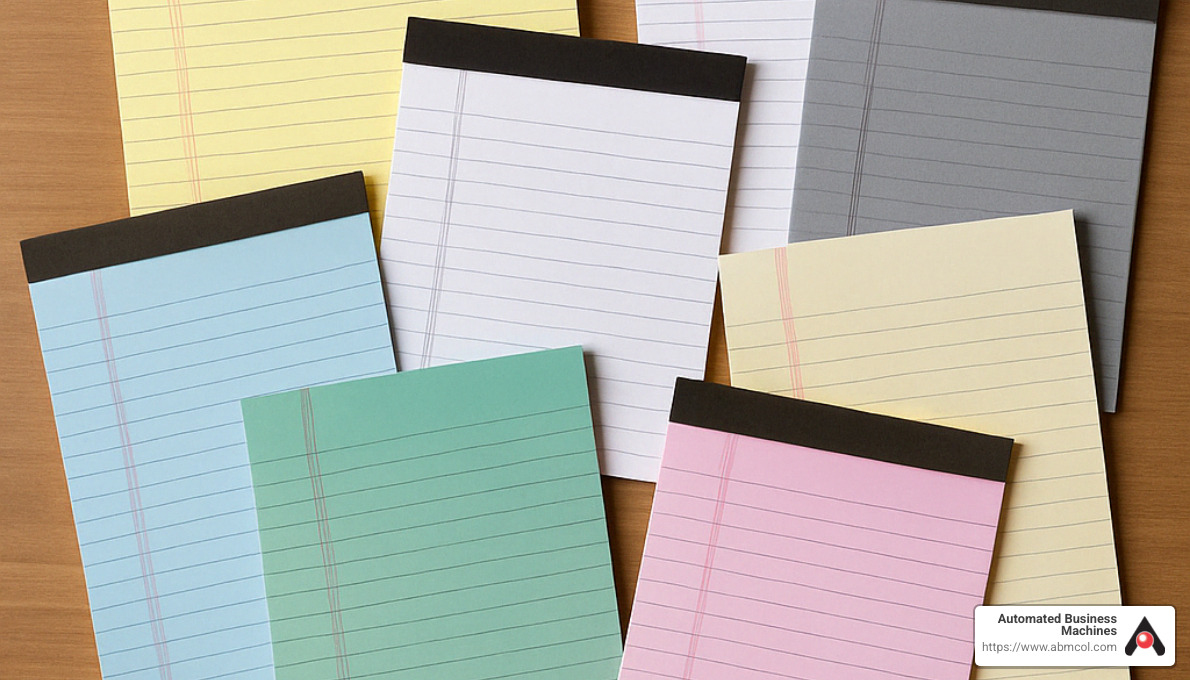
By knowing these features, you can confidently select a legal pad that best supports your needs—whether you’re jotting notes on the go, preparing legal documents, or keeping organized at your desk.
Choosing the Right Legal Pad for Your Needs
When you’re choosing the ideal legal pad, it’s all about finding the sweet spot between functionality, comfort, and practicality. With numerous choices available regarding the size of legal pad, ruling styles, and additional features, it helps to take a thoughtful approach. Let’s explore how you can match your needs perfectly with the right legal pad.
Consider Your Primary Use Case
The first step is thinking about how you’ll primarily use your legal pad. Different settings call for different pad styles.
Legal professionals, for instance, often prefer the traditional legal size (8.5 x 14 inches). It’s what clients and courts typically expect, providing plenty of room for detailed notes and documentation. Perforated pages are popular because they allow easy removal for filing or sharing notes. Wirebound pads are particularly useful in client meetings since you can easily flip pages back to reference earlier notes. And don’t underestimate the power of classic yellow paper—it helps reduce eye strain during long hours of reading and drafting documents.
Students often find letter size pads (8.5 x 11 inches) the most convenient. They’re the perfect fit for backpacks and binders, and college-ruled versions let you capture plenty of class notes per page. Three-hole punched pads make storing your notes in binders effortless. Plus, affordable multi-pad packs help stretch your student budget throughout the semester.
For field workers who are constantly on the move, junior-sized pads (5 x 8 inches) offer unbeatable portability. These compact pads slip easily into pockets and bags, and wirebound versions give you a sturdy writing surface even without a desk nearby. Consider weather-resistant covers to protect your notes from the elements, and opt for perforated pages if you’ll need to share information quickly.
And let’s not forget the executive setting, where first impressions matter. Premium paper quality (20-24 lb) combined with professional binding and an attractive cover design can impress during meetings or presentations. Letter-sized pads work well here since they fit neatly into standard folders and briefcases, and white paper tends to offer a clean, professional appearance.
Evaluate Your Writing Style
Your personal handwriting habits are another big factor when choosing the right pad. If your writing tends to be larger and more spread out, wide-ruled lines offer comfortable spacing. However, if your notes tend to be small and densely packed, narrow-ruled pads maximize your available writing space.
If you’re someone who presses down hard when you write, consider thicker paper options (20 lb or higher). And for frequent erasers or note-changers, a more durable, high-quality paper will reduce annoying tears and wear.
Consider Environmental Impact
If you’re concerned about sustainability—and who isn’t these days?—consider eco-friendly legal pad options. At Automated Business Machines, we’ve helped businesses around Georgia, from Johns Creek to Albany, integrate environmentally responsible office products into their workflow.
Eco-friendly pads can include recycled content (typically between 15-30% post-consumer waste). Some pads are produced using renewable energy sources, while others use chlorine-free or sustainably certified paper. Choosing these options can help your business visibly demonstrate your commitment to sustainability without sacrificing convenience or quality. To learn more about affordable and eco-friendly paper options, visit our Affordable Legal Size Paper Options page.
Tips for Selecting the Ideal Legal Pad
It’s wise to test out individual pads before committing to bulk buying. Everyone has unique preferences, and what seems ideal on paper might not match your daily workflow. Also, think about practical storage and portability—will the pad fit comfortably into your desk, bag, or filing system?
Balancing quality and cost is important. Premium pads may cost a bit more upfront, but they reduce frustrating bleed-through and tearing, making your note-taking experience more enjoyable and productive.
Think about how your notes integrate with your other systems. If you often digitize your notes later, consider how easily your chosen format fits into this digital workflow. Finally, lighting conditions matter too! Yellow paper works wonders in bright lights, reducing eyestrain, while white paper might be easier to read in dimmer environments.
Real-Life Impact: Choosing the Right Size of Legal Pad
At Automated Business Machines, we’ve personally witnessed how selecting the right pad can boost productivity and improve workflow. One attorney in our Atlanta office mentioned a noticeable improvement in organization after switching to different pad sizes based on tasks. He shared with us:
“After years of using standard legal pads for everything, switching to a mix of sizes based on specific tasks has noticeably improved my organization and reduced waste. Using junior pads for client meetings and full legal size for case preparation has been a game-changer.”
Whether you’re a busy lawyer in Atlanta, an accountant in Macon, or part of a government agency in Savannah, Automated Business Machines can help you choose customized solutions that fit your exact needs—including selecting the right size of legal pad. To learn more about standard paper dimensions, visit our Standard Printer Paper Size Information page.

Conclusion
Choosing the right size of legal pad can genuinely improve how well you organize your thoughts, notes, and official documents. While the traditional legal pad measures 8.5 x 14 inches, today you’ll find a variety of options—including junior (5 x 8 inches) and letter size (8.5 x 11 inches)—making it easy to find the perfect pad for your individual needs.
Interestingly, what truly makes a legal pad “legal” isn’t its overall size, but rather a simple yet important detail: the distinctive 1-1/4″ vertical margin along the left edge of the page. This margin gives you a dedicated space for annotations, numbering, and keeping your ideas neatly aligned.
When selecting your ideal legal pad, consider more than just dimensions. Features like ruling style, paper color, binding type, and perforations play a significant role in how effective (and enjoyable!) your note-taking can be. For example, wide-ruled pads are great if you have larger handwriting or prefer more breathing space between lines, while narrow-ruled pads let you maximize notes per page. Traditional yellow “canary” pads offer better contrast, reducing eye strain during long sessions, while white paper can provide a more formal look.
At Automated Business Machines, we’ve learned from experience that seemingly minor details—like choosing the right pad—really do impact workflow and productivity. That’s why our locally owned and operated team works with clients across Georgia, from Atlanta to Savannah and Columbus to Augusta, to create customized document solutions that fit their unique needs.
Perhaps you’re looking to streamline your paper supplies, reduce environmental impact, or even integrate your handwritten notes into a digital workflow. Whatever your goals, we can help you select the best combination of legal pad sizes, styles, and eco-friendly options to match your preferences and tasks.
And if you’re ready to go beyond paper, our multifunction printing solutions and digital signage services offer advanced technology custom specifically to your organization’s needs. We specialize in secure printing and digital workflows, helping Georgia businesses seamlessly blend traditional and digital document management.
Even in our increasingly tech-driven offices, the humble legal pad remains a beloved classic. By thoughtfully considering the size of legal pad and related features, you can ensure this trusty tool continues helping you stay organized, efficient, and productive.
To learn more about optimizing your document workflow or exploring our range of advanced business solutions, visit Automated Business Machines today—we’d love to help you boost your productivity in smart, simple, and effective ways.