
AI Overview:
This guide clears up the biggest misconceptions about copier leasing by comparing real total cost of ownership, hidden fees, lease types, and upgrade options. It explains when leasing can actually cost less than buying, how maintenance and tax treatment change the math, and which fine-print charges businesses must watch for. Readers also learn negotiation tips, how upgrades work during a lease, and why many SMBs prefer predictable monthly costs over large upfront purchases. Throughout the guide, ABM highlights how its transparent quotes, maintenance-included plans, and local Georgia service help businesses avoid surprises and choose the right lease structure with confidence.
Debunking Copier Leasing Myths — Clear, Practical Answers on Lease vs. Buy, Hidden Costs, and Contract Terms
Leasing a copier can spark strong opinions — and a lot of confusion. This guide cuts through common misconceptions and focuses on the practical trade‑offs decision makers should weigh before signing a contract. We identify the myths you hear most often, explain why they persist, and share evidence‑based facts about total cost of ownership, hidden fees, lease structures, upgrade paths, and contract traps. You’ll learn how leasing can preserve cash flow, how different lease types affect taxes and ownership, which fees typically surprise organizations, and negotiation tactics that win flexible terms. Each section pairs clear, neutral analysis with short notes on how Automated Business Machines (ABM) supports Georgia businesses. The guide covers cost comparisons, example hidden costs, lease‑type comparisons, upgrade mechanics, SMB suitability, scam red flags, FAQs, and ABM’s local leasing advantages.
Is Leasing a Copier Always More Expensive Than Buying?
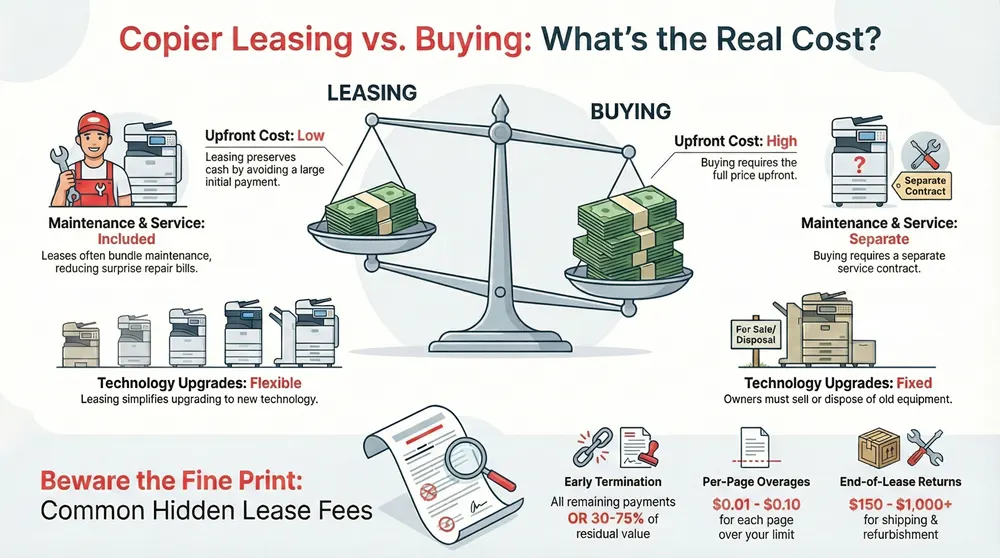
Leasing a copier isn’t automatically pricier than buying — it depends on total cost of ownership (TCO), how much you use the device, whether service is included, and tax treatment. Leasing turns a large upfront capital expense into predictable operating costs, preserves cash flow, and often includes maintenance that limits surprise repair bills. For many organizations, a monthly lease payment that includes service can produce a lower effective annual cost than ownership once you factor in depreciation, resale uncertainty, and separate service contracts. Deciding which path makes sense starts with a side‑by‑side look at the core attributes that drive TCO.
What Are the True Cost Differences Between Leasing and Buying?
The core differences come down to upfront cost, monthly payment, maintenance inclusion, depreciation, and residual value — each shifts the TCO balance. Buying requires a larger initial outlay but can be cheaper over many years if the device is heavily used and kept past its economic life. Leasing evens out expenses and usually bundles service, which reduces unexpected capital spending. Picture a medium‑use multifunction printer: ownership brings depreciation and possible service contracts, while a lease often includes maintenance and steady monthly costs that simplify budgeting. These trade‑offs explain why medium‑term leases appeal to organizations prioritizing flexibility and predictable operating expenses, which leads into the tax and cash‑flow discussion below.
How Does Leasing Preserve Cash Flow and Offer Tax Benefits?
Leasing preserves working capital by avoiding a large one‑time payment and turning equipment costs into operating expenses — freeing cash for other priorities. Operating leases are typically treated as operating expenses for accounting purposes and, under many tax frameworks, lease payments can be deducted as business expenses rather than capitalized and depreciated. For many small and medium businesses, preserving liquidity plus predictable monthly costs makes budgeting easier and keeps refresh cycles aligned with technology needs. Always consult your accountant for specifics, since lease classification can materially affect tax treatment and the best financial choice for your company.
| Comparison Attribute | Leasing (Typical) | Buying (Typical) |
|---|---|---|
| Upfront Cost | Low or none | High (purchase price) |
| Monthly Cost | Predictable lease payments | Possibly lower monthly but variable (service) |
| Maintenance Included | Often yes (with service plan) | Often separate contract |
| Tax Treatment | Expense deduction of payments | Depreciation and interest deduction rules |
| Upgrade Flexibility | High (refresh options) | Low without resale/buyout |
| Ownership at Term | No (unless buyout) | Yes |
The table above highlights the trade‑offs and shows why a true cost comparison must include maintenance, taxes, and upgrade flexibility. Next we break down the hidden fees that can shift the math.
What Are the Common Hidden Costs in Copier Lease Agreements?
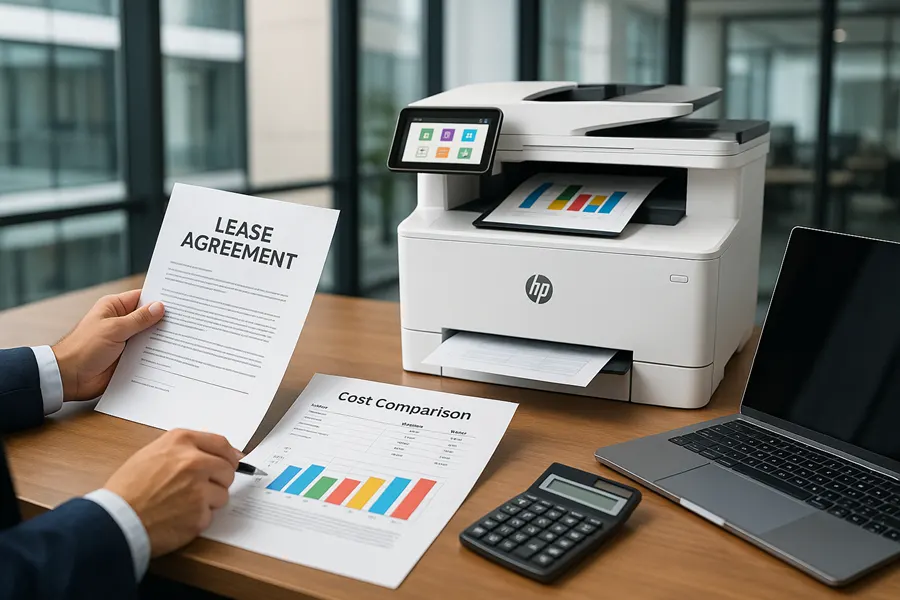
Hidden costs in copier leases can materially raise your TCO and catch budgets off guard if you don’t spot them during contract review. Typical categories include early termination penalties, overage fees for extra copies, end‑of‑lease refurbishment or return shipping charges, and service escalation clauses that raise costs over time. Each fee interacts with your usage patterns and the contract’s language, so knowing common ranges and triggers helps you negotiate protective terms. Below is a practical catalog of likely hidden fees and example impacts to verify before you sign.
Which Hidden Fees Should Businesses Watch For in Copier Leases?
Watch for these fine‑print charges: early termination fees that may be calculated as remaining payments or a percentage of the residual; per‑page overage charges that can add up quickly; end‑of‑lease return fees for pickup, refurbishment, or damage remediation (sometimes billed as repair invoices); and service escalation clauses where labor or parts costs rise annually without caps. Negotiating clear caps, transparent overage rates, and reasonable wear‑and‑tear standards reduces the risk of surprise invoices at lease end.
The table below explains common hidden fee types, how they’re applied, and typical example ranges so you can see their potential impact.
| Fee Type | Attribute | Typical Range / Example Cost |
|---|---|---|
| Early termination | Calculation method | Remaining payments or 30–75% of residual |
| Overage charges | Per-page costs | $0.01–$0.10 per excess page |
| End-of-lease returns | Refurbishment/shipping | $150–$1,000+ depending on condition |
| Service escalation | Annual increases | 3–7% annual escalator if unchecked |
| Consumables & parts | What is covered | Supplies sometimes excluded → extra cost |
That table clarifies how each hidden fee works and why they matter for negotiation priorities. Next we’ll review ways to mitigate these risks and how reliable vendors keep costs transparent.
How Does ABM Ensure Transparency to Avoid Unexpected Lease Fees?
Automated Business Machines (ABM) focuses on clear, itemized quotes, straightforward contract language, and maintenance‑inclusive plans to reduce surprise fees for Georgia businesses. ABM spells out what maintenance covers, how overage charges are calculated, and the available end‑of‑lease options so clients can budget with confidence. We encourage prospective lessees to request detailed, itemized quotes and to review contract clauses before signing. Ask for written caps on escalators, a clear definition of normal wear, and a stated list of included consumables — those elements go a long way toward avoiding downstream disputes.
Are All Copier Lease Agreements the Same? What Should You Know?
No — copier leases vary widely. Lease type, term length, payment schedule, and end‑of‑lease options create very different obligations and costs. Common structures include Fair Market Value (FMV) leases, $1 buyout leases, capital/finance leases, and short‑term rentals, and each affects accounting, ownership, and upgrade flexibility differently. Learn key terms like residual value, maintenance inclusion, auto‑renewal, and buyout options so you can pick the structure that matches your cash‑flow, tax, and technology lifecycle preferences.
What Lease Terms Affect Your Copier Agreement?
Several contract terms change your obligations: term length affects monthly payment size and upgrade timing; auto‑renewal clauses can unintentionally extend commitments; maintenance inclusion shifts operational risk; and damage or excessive wear liability can create end‑of‑lease costs. Pay close attention to who supplies consumables, acceptable wear thresholds, and defined SLAs. Negotiators should insist on explicit language for response times, parts coverage, and how overages are calculated to reduce ambiguity and align outcomes with expectations.
How Can You Negotiate Flexible Lease Terms and Upgrade Options?

Ask for explicit upgrade clauses, predefined refresh windows, early upgrade credits, and service‑level agreements with guaranteed response times and escalation paths. A documented addendum for future upgrades or a short‑term lease option preserves flexibility if your technology needs change quickly. Negotiate caps on annual service escalators to limit long‑term surprises. Sample contract language you can request includes defined upgrade windows, trade‑in credit formulas, and clear end‑of‑lease pathways — and have legal and financial advisors review those terms before signing. These levers help leasing support modernization without punitive penalties.
| Lease Type | Term Length | Typical Monthly Payment Profile | End-of-Lease Options |
|---|---|---|---|
| FMV lease | 36–60 months | Lower monthly payments | Return, renew, or negotiate FMV buyout |
| $1 buyout lease | 36–60 months | Higher monthly (includes buyout) | Own equipment for $1 at term end |
| Capital / finance lease | Varies | Structured as purchase payments | Ownership or financed purchase |
| Short-term lease | Weeks–12 months | Higher monthly rate | Return or extend short-term |
This comparison shows how term and payment structure determine end‑of‑lease outcomes and which approach fits different business strategies. Next we’ll cover upgrade mechanics in more detail.
Can You Upgrade or Change Your Copier During a Lease?
Yes — upgrades and equipment changes are usually possible, but the contract terms determine how. Common paths include an early upgrade clause with a trade‑in credit, executing a lease buyout and replacing the unit, or transferring the lease when allowed. Each option has cost and procedural implications — for example, you may need to cover a buyout or remaining payments — so balance those costs against the benefits of newer technology and greater efficiency. Laying out upgrade options in advance minimizes downtime and clarifies payment and maintenance impacts.
What Are Your Options for Early Upgrades or Equipment Changes?
Typical options are an early upgrade clause offering an agreed trade‑in credit, negotiating a lease addendum for a technology refresh, or buying out the current lease then leasing replacement equipment. The right choice depends on remaining term, residual values, and any early termination fees; trade‑in credits can offset buyout amounts and simplify transitions. Coordinating upgrades with managed print services preserves supplies, service continuity, and document workflows while reducing downtime. Clear, documented upgrade paths and cost formulas in the original lease make later decisions smoother.
How Does Leasing Help Avoid Outdated Copier Technology?
Leasing aligns device terms with common refresh cycles (typically 36–60 months), letting organizations adopt updated security features, faster print engines, and better workflows without holding obsolete equipment on the balance sheet. Structuring leases with refresh clauses or short renewal options reduces the risk of sunk costs from outdated devices and keeps you compatible with managed IT and document management solutions. Leasing also provides access to current models and firmware updates that support modern security standards and cloud integrations. Planning refresh timelines during negotiation makes leasing a practical lifecycle management tool rather than a long‑term burden.
Is Copier Leasing Only Suitable for Large Businesses?
Not at all — leasing fits businesses of every size. Small and medium businesses often benefit from lower upfront costs, bundled maintenance, and predictable monthly expenses that simplify budgeting. Leasing removes the capital barrier to acquiring advanced multifunction printers and managed services that might otherwise be out of reach. For very high‑volume enterprises, buying can make sense if devices will be used intensively for many years, but leasing remains attractive where flexibility and rapid upgrades matter. The next section outlines concrete SMB benefits and explains how local support changes the experience.
What Are the Benefits of Copier Leasing for Small and Medium Businesses?
SMBs see clear advantages: conserved capital and better cash flow, predictable service and per‑page costs with maintenance included, reduced IT burden when bundling managed print, and scalability to add or change devices as the business grows. Leasing shifts upkeep to the provider so internal teams can focus on core work. A common SMB choice is a 36‑month lease with maintenance included — it delivers current features and fixed monthly costs that simplify financial planning. For growing businesses, leasing is a practical way to get the capabilities they need without straining resources.
How Does ABM Support Local Georgia Businesses with Copier Leasing?
Automated Business Machines (ABM) serves Georgia markets — including Atlanta, Columbus, Augusta, and Savannah — with local expertise, flexible lease options, and integrated managed services that combine copier leasing with managed print and managed IT. ABM emphasizes transparent quotes, included installation and maintenance for supported brands, and the ability to tailor lease terms to company size and technical needs to minimize downtime and hidden costs. A local presence means faster service response and more customized contract discussions that reflect regional realities. Prospective lessees in Georgia should request a detailed, itemized quote to understand true TCO and included services.
Key local leasing advantages ABM highlights:
- Local service teams with regional knowledge and faster expected response times.
- Flexible lease structures matched to SMB growth and technology refresh needs.
- Integrated managed print and IT services to reduce vendor complexity.
How Can You Avoid Copier Lease Scams and Complicated Contracts?
Spotting scams and unfair terms takes careful contract review, attention to vendor behavior, and insistence on written, explicit fee and service terms. Red flags include vague fee language, high‑pressure sales tactics, refusal to provide itemized quotes, automatic renewal clauses without a clear opt‑out, and unclear end‑of‑lease remediation charges. Use a contract checklist and a vendor evaluation process: demand transparent pricing, request sample end‑of‑lease invoices, verify maintenance scope, and confirm SLA response expectations in writing. The list below highlights specific warning signs and safeguards to protect your organization.
What Red Flags Indicate Potential Lease Scams or Unfair Terms?
Watch for these warning signs when evaluating proposals:
- Vague fee language: Contracts that don’t spell out overage rates, refurbishment costs, or escalation caps.
- Pressure tactics: Being rushed to sign without time for review or counsel.
- Auto-renewal traps: Renewal language that extends the lease automatically without clear notice or opt‑out.
- Unclear maintenance scope: Service plans missing details on parts, labor, consumables, and response windows.
- Excessive penalties: Disproportionate early termination or damage fees not clearly linked to actual cost.
Why Choose ABM for Transparent and Ethical Copier Leasing Solutions?
ABM’s approach centers on transparent quoting, maintenance‑inclusive contracts, and clear end‑of‑lease options designed to reduce ambiguous fees and simplify decision‑making for clients in Georgia. Our local footprint and service focus aim to deliver documented SLAs, included installation and maintenance for supported brands, and explicit contract language that clarifies overages and refurbishment responsibilities. Choosing a vendor who provides clear, written terms and itemized quotes is one of the best safeguards when leasing equipment — ABM builds its services around those transparency principles. Prioritize documented policies and written escalation processes when evaluating providers.
Frequently Asked Questions
What Should I Consider When Choosing Between Different Lease Types?
When choosing a lease type, weigh your cash‑flow needs, usage patterns, and technology goals. Common options are Fair Market Value (FMV) leases, $1 buyout leases, and capital leases, each with distinct tax and accounting outcomes. Compare total cost of ownership, maintenance coverage, and upgrade flexibility to find the best fit. If needed, consult financial advisors to understand long‑term budget and lifecycle effects.
How Can I Ensure I Get the Best Lease Terms?
Get multiple quotes to understand market rates and be ready to negotiate. Focus on maintenance inclusions, upgrade options, and potential hidden fees. Ask for clear definitions of terms and conditions and consider legal or financial review before signing. Request flexibility in upgrade timing and payment structure so the lease can adapt as your business changes.
What Are the Risks of Not Reviewing a Copier Lease Agreement Thoroughly?
Skipping a detailed review can lead to unexpected costs and unfavorable terms: hidden fees, unclear maintenance responsibilities, and auto‑renewal clauses are common pitfalls. You might miss usage limits or heavy early termination penalties, leading to financial or operational headaches. Always read the fine print and get clarification on ambiguous terms before you commit.
Can I Transfer My Copier Lease to Another Business?
Transferring a copier lease is sometimes allowed but depends on the contract. Many leases permit assignment with the lessor’s approval and may include transfer conditions. If you think you might need to transfer the lease, negotiate clear transfer provisions up front and discuss options with the vendor before signing.
What Should I Do If I Encounter Issues with My Copier Lease?
If you run into problems like unexpected fees or service shortfalls, first review your contract to identify relevant terms. Document discrepancies, communicate with the vendor, and escalate to a supervisor if needed. If issues remain unresolved, seek legal advice. Keep a record of all communications and invoices to support your case.
How Often Should I Review My Copier Lease Agreement?
Review your lease at least annually or whenever your operations change significantly. Regular reviews keep terms aligned with current needs and alert you to upcoming end‑of‑lease dates or renewal clauses. Use reviews to spot renegotiation or upgrade opportunities so your equipment keeps pace with your business.
Should I Buy or Lease a Copier?
Decide with usage, cash‑flow priorities, and refresh needs in mind: lease if you prefer lower upfront cost, predictable monthly spending, and easier upgrades; buy if you expect heavy, long‑term use that yields lower total cost after depreciation. Compare TCO over the expected life, factor in maintenance and tax treatment, and get itemized quotes to compare scenarios. Talk with financial and IT advisors to match procurement to growth plans and risk tolerance.
How Much Does a Copier Lease Typically Cost?
Most leases run 36–60 months. Monthly costs vary by model, included services, and expected monthly volume — light office models cost much less than high‑volume multifunction systems. Factors that affect price include maintenance inclusion, page volume, color vs. black‑and‑white capability, and upgrade clauses. Maintenance‑included plans usually raise the base lease rate but reduce unexpected repair expenses. For accurate budgeting, ask for an itemized quote showing base lease rate, included pages, overage charge, and any escalation terms.
How Do Copier Lease Agreements Work?
A lease contract sets out the parties, payment schedule, maintenance responsibilities, permitted use, and end‑of‑lease options. Typical lifecycle steps are quote and selection, contract negotiation (with explicit terms for maintenance and overages), installation, ongoing service and usage monitoring, and end‑of‑lease choices — return, renew, or buyout. Verify residual value formulas, buyout options, early termination calculations, and clear definitions of normal wear and consumable responsibilities before you sign.
Are Maintenance and Repairs Included in Copier Leases?
Many leases include maintenance and repair under a managed plan, but coverage varies: some plans cover labor and parts, others exclude consumables or certain components. Confirm the SLA for guaranteed response times, parts coverage, escalation procedures, and what counts as billable repairs versus included maintenance. Clarifying SLA metrics and consumable coverage prevents surprise bills and keeps ownership costs predictable.
How Can I Get Out of a Copier Lease Early?
Getting out early usually means negotiating a settlement, buying out the lease based on residual formulas, transferring the lease if allowed, or using contractual early termination provisions that may carry penalties. The cheapest path depends on the remaining term, current equipment value, and vendor flexibility. Some vendors offer early‑upgrade or trade‑in credits that reduce termination costs. Negotiate buyout formulas and transfer provisions at signing to preserve options later.
What Makes ABM’s Copier Leasing Advantage Unique?
ABM’s advantage is local expertise in Georgia markets, flexible lease options, maintenance‑inclusive packages, and partnerships with leading brands to support productivity and IT integration. We combine leasing, sales, repair, managed print, managed IT, and document management to provide coordinated procurement and lifecycle support. ABM’s strengths are transparent quoting, flexible terms, and local service that lowers downtime risk and simplifies vendor management for organizations seeking predictable TCO and integrated solutions. Below are the local benefits and service offerings we highlight.
How Does ABM’s Local Expertise Benefit Georgia Businesses?
ABM’s Georgia focus — serving Atlanta, Columbus, Augusta, and Savannah — delivers tailored service with faster local response and contracts adapted to regional needs, reducing downtime and administrative friction. Local technicians and account teams coordinate installations, maintenance, and managed print or IT integrations more efficiently than remote providers, and that proximity often means clearer communication and quicker problem resolution. Asking a local partner for an itemized, transparent quote helps ensure service expectations and regional logistics are addressed before signing.
Which Top Copier Brands and Services Does ABM Offer?
ABM partners with recognized industry brands and offers a range of equipment and services: copier and printer leasing and sales, repair, managed print services, managed IT, and document management solutions to meet varied business needs. We list partnerships with brands such as HP, Toshiba, Lexmark, and Fujitsu and bundle installation, maintenance, and repair to simplify procurement. Compare itemized quotes and service scopes to confirm brand availability, maintenance inclusions, and upgrade pathways when evaluating proposals.
ABM service offerings summarize:
Leasing and sales of MFPs from major brands.Maintenance, repair, and managed print services bundled by agreement.Managed IT and document management options integrated with equipment leases.
https://shorturl.fm/YPX9c
https://shorturl.fm/2hVbQ
https://shorturl.fm/GoCbb
https://shorturl.fm/8TYCo
https://shorturl.fm/k7rdu
https://shorturl.fm/tZ4b8
Your point of view caught my eye and was very interesting. Thanks. I have a question for you.
I don’t think the title of your article matches the content lol. Just kidding, mainly because I had some doubts after reading the article.
Can you be more specific about the content of your article? After reading it, I still have some doubts. Hope you can help me.
Thank you for your sharing. I am worried that I lack creative ideas. It is your article that makes me full of hope. Thank you. But, I have a question, can you help me? https://www.binance.com/bg/register?ref=V2H9AFPY
Your article helped me a lot, is there any more related content? Thanks!
Thank you for your sharing. I am worried that I lack creative ideas. It is your article that makes me full of hope. Thank you. But, I have a question, can you help me? https://accounts.binance.com/sl/register-person?ref=I3OM7SCZ
Thanks for sharing. I read many of your blog posts, cool, your blog is very good. https://accounts.binance.com/hu/register-person?ref=IQY5TET4
Thanks for sharing. I read many of your blog posts, cool, your blog is very good.
Your point of view caught my eye and was very interesting. Thanks. I have a question for you.
https://shorturl.fm/0lfJt
I don’t think the title of your article matches the content lol. Just kidding, mainly because I had some doubts after reading the article.
https://shorturl.fm/efT9b
https://shorturl.fm/JsZMA
https://shorturl.fm/T6rTr
Solid analysis of tournament dynamics! Seeing platforms like arion play slot download prioritize security & responsible gaming is key for long-term player trust – a good sign for the PH market. Risk management is crucial, both at the tables & online!
Your article helped me a lot, is there any more related content? Thanks! https://accounts.binance.com/en-ZA/register?ref=B4EPR6J0
https://shorturl.fm/FPUmX
Your point of view caught my eye and was very interesting. Thanks. I have a question for you. https://accounts.binance.com/id/register?ref=UM6SMJM3
Volatility in slots is fascinating – seeing how platforms like JILI88 approach probability is key for players. Legit operators prioritize data integrity, and exploring options like the jili88 club can be insightful for understanding fair play mechanics. It’s all about informed choices!
Thanks for sharing. I read many of your blog posts, cool, your blog is very good.
I don’t think the title of your article matches the content lol. Just kidding, mainly because I had some doubts after reading the article. https://accounts.binance.info/zh-CN/register-person?ref=WFZUU6SI
I don’t think the title of your article matches the content lol. Just kidding, mainly because I had some doubts after reading the article.
Can you be more specific about the content of your article? After reading it, I still have some doubts. Hope you can help me. https://www.binance.info/register?ref=IXBIAFVY
I don’t think the title of your article matches the content lol. Just kidding, mainly because I had some doubts after reading the article. https://www.binance.info/fr/register?ref=T7KCZASX
Can you be more specific about the content of your article? After reading it, I still have some doubts. Hope you can help me.
Your article helped me a lot, is there any more related content? Thanks! https://accounts.binance.info/ro/register-person?ref=HX1JLA6Z
Your point of view caught my eye and was very interesting. Thanks. I have a question for you.
Can you be more specific about the content of your article? After reading it, I still have some doubts. Hope you can help me.
Your article helped me a lot, is there any more related content? Thanks! https://accounts.binance.info/cs/register-person?ref=OMM3XK51
Thanks for sharing. I read many of your blog posts, cool, your blog is very good.
Your point of view caught my eye and was very interesting. Thanks. I have a question for you.
Your point of view caught my eye and was very interesting. Thanks. I have a question for you. https://www.binance.info/es/register?ref=RQUR4BEO
Thank you for your sharing. I am worried that I lack creative ideas. It is your article that makes me full of hope. Thank you. But, I have a question, can you help me? https://accounts.binance.com/es-AR/register?ref=UT2YTZSU
Thanks for sharing. I read many of your blog posts, cool, your blog is very good.
Your article helped me a lot, is there any more related content? Thanks! https://www.binance.info/hu/register?ref=IQY5TET4
Thank you for your sharing. I am worried that I lack creative ideas. It is your article that makes me full of hope. Thank you. But, I have a question, can you help me?
Can you be more specific about the content of your article? After reading it, I still have some doubts. Hope you can help me. https://accounts.binance.info/si-LK/register?ref=LBF8F65G
Thanks for sharing. I read many of your blog posts, cool, your blog is very good.
I don’t think the title of your article matches the content lol. Just kidding, mainly because I had some doubts after reading the article.
I don’t think the title of your article matches the content lol. Just kidding, mainly because I had some doubts after reading the article.
Thank you for your sharing. I am worried that I lack creative ideas. It is your article that makes me full of hope. Thank you. But, I have a question, can you help me? https://www.binance.info/el/register?ref=DB40ITMB
https://shorturl.fm/ltzC8
I don’t think the title of your article matches the content lol. Just kidding, mainly because I had some doubts after reading the article.
Your article helped me a lot, is there any more related content? Thanks!
https://shorturl.fm/K7iZc
Thanks for sharing. I read many of your blog posts, cool, your blog is very good. https://accounts.binance.info/ar/register-person?ref=PORL8W0Z
Your point of view caught my eye and was very interesting. Thanks. I have a question for you. https://www.binance.com/register?ref=IXBIAFVY
Thank you for your sharing. I am worried that I lack creative ideas. It is your article that makes me full of hope. Thank you. But, I have a question, can you help me?
Can you be more specific about the content of your article? After reading it, I still have some doubts. Hope you can help me. https://www.binance.com/ru/register?ref=O9XES6KU
Can you be more specific about the content of your article? After reading it, I still have some doubts. Hope you can help me.
Thank you for your sharing. I am worried that I lack creative ideas. It is your article that makes me full of hope. Thank you. But, I have a question, can you help me? https://accounts.binance.info/fr/register?ref=T7KCZASX
Thanks for sharing. I read many of your blog posts, cool, your blog is very good. https://www.binance.info/en-NG/register?ref=YY80CKRN
Thank you for your sharing. I am worried that I lack creative ideas. It is your article that makes me full of hope. Thank you. But, I have a question, can you help me? https://www.binance.info/bn/register-person?ref=WTOZ531Y
Your point of view caught my eye and was very interesting. Thanks. I have a question for you. https://accounts.binance.info/register-person?ref=IXBIAFVY
Your article helped me a lot, is there any more related content? Thanks!
Your article helped me a lot, is there any more related content? Thanks!
Your point of view caught my eye and was very interesting. Thanks. I have a question for you. https://accounts.binance.info/en/register-person?ref=JHQQKNKN
Your point of view caught my eye and was very interesting. Thanks. I have a question for you. https://www.binance.info/sl/register?ref=GQ1JXNRE
Thanks for sharing. I read many of your blog posts, cool, your blog is very good.
Your point of view caught my eye and was very interesting. Thanks. I have a question for you. https://accounts.binance.info/bg/register-person?ref=V2H9AFPY
Your article helped me a lot, is there any more related content? Thanks!
Your article helped me a lot, is there any more related content? Thanks! https://www.binance.info/en-NG/register?ref=YY80CKRN
Your point of view caught my eye and was very interesting. Thanks. I have a question for you. https://accounts.binance.com/zh-TC/register?ref=DCKLL1YD
Thanks for sharing. I read many of your blog posts, cool, your blog is very good.
Thanks for sharing. I read many of your blog posts, cool, your blog is very good.
Thanks for sharing. I read many of your blog posts, cool, your blog is very good. https://accounts.binance.info/cs/register-person?ref=OMM3XK51
Thanks for sharing. I read many of your blog posts, cool, your blog is very good.
Thank you for your sharing. I am worried that I lack creative ideas. It is your article that makes me full of hope. Thank you. But, I have a question, can you help me? https://www.binance.com/id/register?ref=UM6SMJM3
Thanks for sharing. I read many of your blog posts, cool, your blog is very good. https://www.binance.info/ph/register?ref=IU36GZC4
Thank you for your sharing. I am worried that I lack creative ideas. It is your article that makes me full of hope. Thank you. But, I have a question, can you help me?
Thanks for sharing. I read many of your blog posts, cool, your blog is very good.
I don’t think the title of your article matches the content lol. Just kidding, mainly because I had some doubts after reading the article.
Your point of view caught my eye and was very interesting. Thanks. I have a question for you.
Your article helped me a lot, is there any more related content? Thanks! https://accounts.binance.com/hu/register?ref=IQY5TET4
I don’t think the title of your article matches the content lol. Just kidding, mainly because I had some doubts after reading the article. https://accounts.binance.info/ro/register-person?ref=HX1JLA6Z
Thanks for sharing. I read many of your blog posts, cool, your blog is very good. https://www.binance.info/register?ref=IHJUI7TF
Your article helped me a lot, is there any more related content? Thanks!
Your article helped me a lot, is there any more related content? Thanks!
Your article helped me a lot, is there any more related content? Thanks! https://accounts.binance.com/tr/register?ref=MST5ZREF
Thank you for your sharing. I am worried that I lack creative ideas. It is your article that makes me full of hope. Thank you. But, I have a question, can you help me?
Thank you for your sharing. I am worried that I lack creative ideas. It is your article that makes me full of hope. Thank you. But, I have a question, can you help me? https://accounts.binance.com/register-person?ref=IXBIAFVY
Thank you for your sharing. I am worried that I lack creative ideas. It is your article that makes me full of hope. Thank you. But, I have a question, can you help me?
I don’t think the title of your article matches the content lol. Just kidding, mainly because I had some doubts after reading the article.
Your point of view caught my eye and was very interesting. Thanks. I have a question for you.