

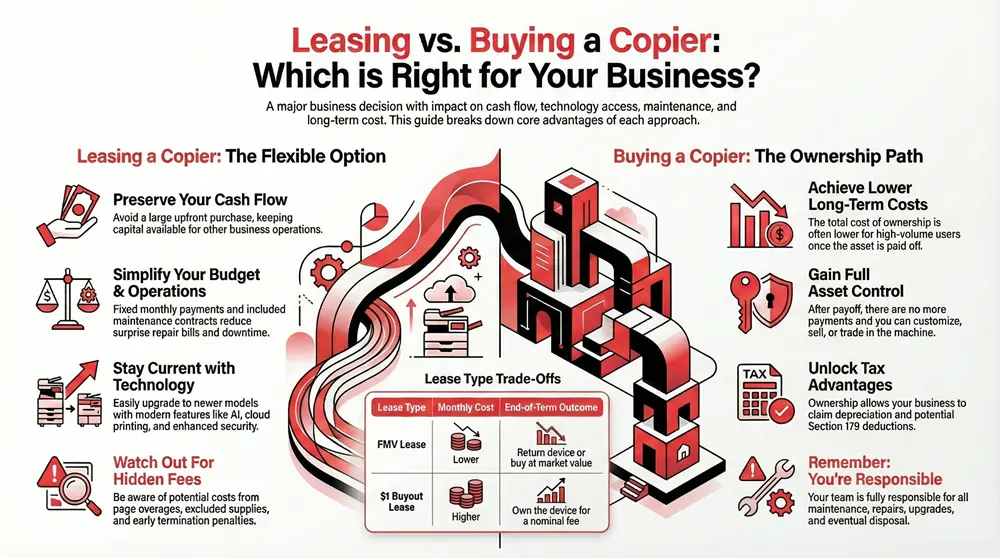
Leasing vs. Buying Copiers: Your Practical Guide to Choosing Between Copier Leases and Purchases
Deciding to lease or buy copiers is more than a purchase — it’s a business decision that affects cash flow, access to current technology, who handles repairs, and your long‑term cost of ownership. This guide explains leasing and buying for office copiers, how each choice shows up on financial statements and daily operations, and the trade‑offs for small, mid‑size, and enterprise teams. You’ll get clear explanations of common lease types (FMV, $1 buyout, capital leases), how maintenance and managed print services change the value proposition, and a straightforward way to compare 36‑ and 60‑month cost scenarios. We also cover contract pitfalls, tax items like Section 179 versus operating lease treatment, and trends — AI, cloud printing, and sustainability — that should factor into your acquisition plan. Along the way, we’ll clarify how maintenance ties to lease value and how OEM partnerships shape equipment choice so you can pick the best path for your operation.
What Are the Key Benefits of Leasing Office Copiers?
Leasing office copiers gives predictable monthly costs, lower upfront spend, and optional bundled maintenance that reduces unexpected downtime and preserves working capital. With many operating leases, repair risk and parts replacement sit with the vendor, which helps keep devices running and budgets steady. If you need regular technology refreshes, leasing makes it easier to adopt newer MFPs and software like cloud printing or document management without a large capital outlay. Below is a concise list of the core leasing benefits that often guide procurement choices.
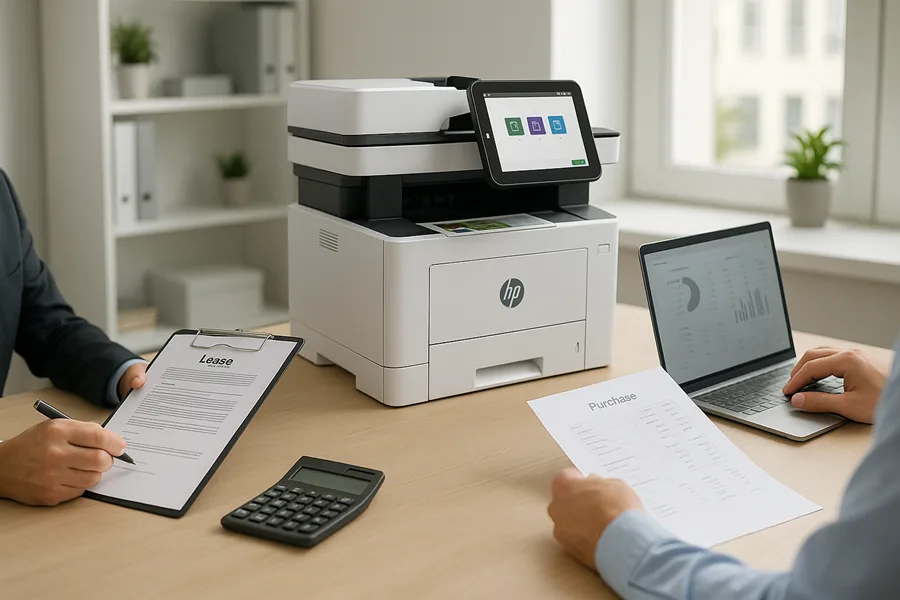
Leasing delivers practical business advantages:
- Lower Upfront Cost: Avoid large capital purchases so you can keep cash available for operations.
- Predictable Monthly Expenses: Fixed payments and bundled service make budgeting simpler.
- Technology Flexibility: Easier refresh cycles let you adopt AI features and cloud integrations sooner.
- Maintenance and Support Included: Service contracts reduce downtime and remove repair logistics from your plate.
These benefits shift the conversation from a one‑time buy to an operational expense model that supports growth and modernization. When comparing vendors, fast local service and bundled managed‑print options are key to realizing these advantages.
| Attribute | Leasing (Typical) | Benefit |
|---|---|---|
| Upfront Cost | Minimal to none | Preserves capital for operations |
| Monthly Payment | Fixed predictable fee | Simplifies budgeting and cash flow |
| Maintenance Included | Often yes (toner, parts, labor) | Reduces downtime and admin overhead |
| Upgrade Flexibility | High (refresh clauses) | Keeps technology current without new capex |
| Tax/Accounting | Operating lease treatment possible | May keep liabilities off balance sheet |
This side‑by‑side shows how leasing mixes financial flexibility with operational support — a strong choice when cash preservation and access to evolving tech matter most. If you want hands‑on help in Georgia, Automated Business Machines (ABM) offers flexible leasing, certified local technicians with fast response, plus free quotes and installation in the Atlanta area. Reach out to get a tailored recommendation, a quote, or to schedule installation.
How Does Leasing Improve Financial Flexibility and Cash Flow?
Leasing turns a large capital purchase into predictable operating payments, preserving cash and keeping borrowing capacity available for growth. That predictability helps businesses with seasonal revenue or rapid scaling because it avoids tying up funds in depreciating equipment. From an accounting viewpoint, operating leases can sometimes keep liabilities off the balance sheet, though classification depends on the lease terms and current accounting rules. Many small Georgia firms prefer leasing when preserving cash and predictable monthly costs matter more than potential resale value of older gear.
Next, we’ll explain the maintenance and support commonly included in copier leases and how service commitments influence total cost of ownership.
What Maintenance and Support Are Included in Copier Lease Agreements?
Typical copier lease agreements include preventive maintenance, parts and labor for common failures, and sometimes supplies like toner under an all‑in contract — all of which reduce surprise repair bills. Service level agreements usually spell out response times and escalation paths; faster SLAs cut downtime and the hidden cost of lost productivity. Managed print services add remote monitoring, meter reporting, and automatic supply replenishment to further simplify administration and lower per‑page costs. When reviewing proposals, be sure to confirm which supplies are excluded, how meter overages are billed, and whether onsite technician response times meet your operational needs.
Knowing these contract details lets you negotiate clear SLAs and avoid unexpected charges at term end — a key input when weighing leasing against buying and how ownership affects maintenance responsibility and long‑term costs.
What Are the Advantages of Buying Office Copiers for Your Business?
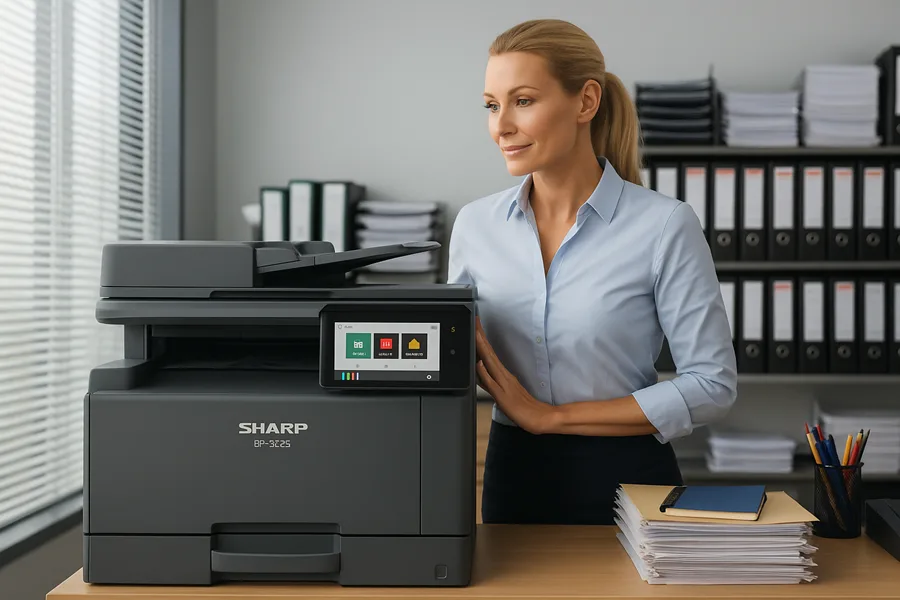
Buying copiers gives you ownership, control over customization, and potential long‑term savings for organizations with steady, high‑volume printing. Ownership enables depreciation (including possible Section 179 treatment) and the option to resell or repurpose equipment to recover part of the investment. High‑duty environments often reach a breakeven where buying costs less than continuous leasing because per‑page costs drop as the asset is amortized. Below are common reasons teams choose to purchase.
Key advantages of purchasing:
- Asset Ownership: No ongoing lease payments after payoff; full control of the equipment.
- Long-Term Cost Savings: Lower per‑page cost for heavy users once the asset is paid off.
- Customization and Integration: Easier to tailor workflows and permanent document‑management integrations.
- Tax Depreciation Opportunities: Ownership supports capital expense treatment and potential Section 179 deductions.
These points favor organizations that can finance a purchase without stressing cash flow and that expect long service life from their machines. Next we’ll walk through how breakeven analysis and long‑term cost comparisons inform the buy‑versus‑lease decision.
How Does Buying Provide Long-Term Cost Savings and Asset Ownership?
Buying converts monthly printing costs into a capital investment that depreciates and can often be offset by resale or trade‑in value, improving total cost of ownership for high‑volume users. A basic breakeven check compares cumulative lease payments to the purchase price plus maintenance and supplies over a 3–5 year window; buying usually wins when annual print volumes are high and equipment life exceeds common lease terms. Ownership avoids end‑of‑term fees and early termination penalties, but it also means you’re responsible for repairs, upgrades, and disposal. Model TCO with downtime, service costs, and resale value to see which route truly saves money.
Tax treatment differs between buying and leasing, so consult your financial advisor when quantifying these savings. The next section outlines common tax considerations.
What Tax Deductions Are Available When Purchasing Copiers?
When you buy copiers, depreciation rules and Section 179 expensing can accelerate tax deductions, potentially lowering the net purchase cost in the year of acquisition. Section 179 lets qualifying equipment be written off up to statutory limits; bonus depreciation and MACRS schedules spread deductions across years. Lease payments, by contrast, are generally deductible as operating expenses, which can offer immediate, predictable tax advantages. Tax rules change and eligibility varies, so work with a tax professional to model after‑tax outcomes for your situation.
With taxes and TCO modeling covered, the next major section explains how copier leases are structured and the lease types you’ll encounter when negotiating.
How Do Copier Lease Agreements Work? Understanding Lease Types and Terms
Copier lease agreements set the financial structure, term length, maintenance responsibilities, and end‑of‑term options. Common lease categories include Fair Market Value (FMV) leases, $1 buyout leases, and capital leases. An FMV lease acts like an operating lease: lower monthly payments and the option to return or upgrade at term end. A $1 buyout moves you to ownership for a nominal fee at term end, effectively financing the purchase. Lease contracts also cover meter charges, overage fees, early termination penalties, and SLA commitments — all negotiation points for controlling total cost.
| Lease Type | Typical Monthly Cost Trend | End-of-Term Options |
|---|---|---|
| FMV (Operating) | Lower monthly payments | Return, renew, or purchase at FMV |
| $1 Buyout | Moderate monthly payments | Buy for $1 (ownership) |
| Capital Lease | Higher monthly (includes principal) | Ownership (treated as financed purchase) |
This table highlights trade‑offs between flexibility, monthly cost, and ownership so you can pick the structure that fits cash flow and tech goals. When choosing a vendor, confirm they can tailor terms and offer the OEM mix you need for performance and budget.
Vendors that customize lease terms and equipment options help bridge technical and financial needs. We at Automated Business Machines (ABM) can structure leases to fit your budget and supply devices from partners like Toshiba, Lexmark, HP, and Fujitsu. If you’d like a tailored quote or consultation, contact our team.
What Is a Fair Market Value Lease vs. a Dollar Buyout Lease?
An FMV lease keeps monthly payments low and lets you return or replace equipment at term end, with purchase optional at a market‑based residual. FMV leases are ideal when you expect regular refreshes and want to limit obsolescence risk. A $1 buyout lease (or dollar buyout) offers a nominal purchase at term end, turning the agreement into a path to ownership once the final payment is made. Choose FMV for low recurring cost and refresh flexibility; choose $1 buyout when eventual ownership and asset control are priorities.
Below we list common hidden costs and red flags to watch for in lease contracts — these can erode any apparent savings if left unaddressed.
How Can You Avoid Hidden Costs and Overage Charges in Copier Leases?
Hidden lease costs often show up as per‑page overages, excluded supplies, service‑call fees, meter disputes, and early termination penalties — any of which can add materially to lifetime cost. To avoid surprises, require transparent meter reporting, capped overage rates or true all‑inclusive pricing, clear SLAs for response and resolution, and written definitions of responsibility for consumables and parts. Negotiate end‑of‑term conditions, damage thresholds, and acceptable wear so you don’t face disputed charges on return. Practical tips: request sample invoices, ask for bundled supplies in proposals, and get upgrade or buyout pricing in writing.
Addressing hidden costs up front protects your TCO model and makes the acquisition decision clearer.
How to Choose Between Leasing and Buying Copiers Based on Business Needs
Choosing between leasing and buying starts with a structured look at budget, print volume, growth plans, IT integration, security, and sustainability — all measured against realistic TCO projections. A decision framework helps weigh short‑term cash preservation against long‑term ownership savings and operational control. If you already use managed IT or managed print services, bundling a lease with those services can improve uptime and simplify vendor management. Use the checklist below to prioritize factors for your purchase strategy.
- Budget & Cash Flow: Is preserving working capital more important than owning the asset?
- Print Volume: Do your monthly pages fall low, medium, or high relative to device duty cycle?
- Growth & Scalability: Will your print needs change significantly in 2–5 years?
- IT & Security Integration: Do you require cloud printing, secure release, or document‑management links?
- Sustainability Plans: Does equipment lifecycle and recycling matter to procurement policy?
What Factors Should Influence Your Copier Acquisition Strategy?
Your strategy should reflect financial limits, reliability needs, expected duty cycles, and the technical ecosystem for document workflows and security. Financially, organizations with limited capital or variable revenue may favor leasing to stabilize cash flow. Operationally, teams that need fast recovery and high uptime should prioritize SLAs and certified local technicians — factors that make leasing with managed print services attractive. Technically, if you need cloud printing or deep document management integration, pick devices and vendors that support those systems. Prioritizing these elements will steer your procurement to the option that minimizes risk and improves workflow efficiency.
Next, see how leasing can pair with managed IT and managed print services to deliver consolidated operational value.
How Does Leasing Integrate with Managed IT and Print Services?
Leasing pairs well with managed print services (MPS) and managed IT by bundling hardware, supplies, monitoring, and service into a single relationship — simplifying billing and cutting administrative overhead. That integration enables remote device monitoring, predictive maintenance, secure pull‑print, and better alignment with IT security policies. Document management systems like Questys, DocForm, and Encompass benefit from vendor support when devices and services are bundled under one contract, which eases onboarding and raises uptime. Automated Business Machines (ABM) offers managed print and managed IT services and supports these document management solutions to reduce complexity and centralize support.
If you want a consolidated service proposal, our team can prepare a bundled plan and tailored quote.
What Are the Typical Costs and Financing Options for Leasing vs. Buying Copiers?
Typical costs include purchase price, monthly lease payments, maintenance and service, supplies, meter overages, and potential end‑of‑term charges. Financing choice strongly affects cash flow and TCO. Common options are vendor leasing (operating or capital), bank equipment loans, and third‑party equipment finance companies; they differ by terms, rates, and accounting treatment. The example table below gives a simplified 36‑ and 60‑month comparison for a mid‑range MFP, showing sample monthly costs and cumulative assumptions.
After you run cost scenarios and financing comparisons, request tailored proposals from vendors who provide transparent quotes and local installation. Automated Business Machines (ABM) serves Georgia markets including Atlanta, Columbus, Augusta, and Savannah and offers free quotes and installation in the Atlanta area. You can Request a Free Quote or schedule a consultation to compare custom options.
How Much Does It Cost to Lease a Copier Compared to Buying?
Lease costs vary by device class, monthly pages, and which services are included. Mid‑level MFPs can be relatively inexpensive monthly under FMV leases, while buyout or capital leases cost more but lead to ownership. Compare maintenance agreements, supply usage, downtime, and potential resale value to determine true TCO. A leased device with inclusive service may show lower admin and predictable per‑page expense, whereas an owned device can be cheaper per page after payback. Model multiple scenarios with realistic meter counts, expected uptime, and end‑of‑term outcomes to find the best financial result.
Next we list common financing choices and when each usually makes sense.
What Copier Financing Options Are Available for Businesses?
Options include vendor leasing (operating or capital), traditional bank equipment loans, and third‑party equipment financiers. Vendor leases simplify procurement by bundling service, while bank loans may offer lower rates to creditworthy borrowers but leave service contracting separate. Finance companies often provide flexible terms for different credit profiles. When comparing, evaluate effective interest rates, total cost over the term, residual values, and whether the financing supports upgrades or early replacement without excessive penalties.
With costs and financing clear, consider industry trends that will affect copier strategy going forward.
What Are the Emerging Industry Trends Impacting Copier Leasing and Buying?
Trends like AI‑driven predictive maintenance, automation in document workflows, cloud printing, and a stronger focus on sustainability are changing the lease‑vs‑buy equation and increasing demand for bundled services. AI features such as failure alerts and secure release workflows reduce downtime and improve security, which raises the value of managed services. Cloud printing and mobile workflows expand device utility but make vendor security and integration capabilities more important. Sustainability concerns drive demand for energy‑efficient models, remanufacturing programs, and leasing options that support responsible lifecycle management rather than outright ownership.
How Are AI, Automation, and Cloud Printing Changing Copier Solutions?
AI and automation bring predictive maintenance, usage analytics, and smarter workflow routing to MFPs, boosting uptime and removing manual admin tasks for IT. Cloud printing and document capture support remote and hybrid work but require secure authentication, encryption, and vendor support for integrations. These advances shift value from hardware alone to integrated services and software that deliver measurable productivity gains. Prioritize vendors offering AI enabled support and proven cloud integrations to future‑proof your print infrastructure.
As these technologies advance, sustainability will also influence procurement choices and the benefits of leasing.
What Are the Environmental and Sustainability Benefits of Leasing Copiers?
Leasing can support sustainability by making it easier to move to energy‑efficient models, centralizing take‑back and remanufacturing, and reducing e‑waste through vendor‑managed lifecycle programs. Leased devices are easier for vendors to refurbish, reuse parts, and recycle responsibly at end‑of‑life, lowering landfill impact compared with unmanaged disposal. Energy‑efficient MFPs reduce power use, and leasing speeds access to those gains without large capital investment. For organizations focused on environmental goals, require documented end‑of‑life handling and upgrade paths in lease agreements to capture both operational and sustainability benefits.
- Checklist: Require clear lifecycle policies, documented energy ratings, and vendor commitments to refurbishment when evaluating offers.
- Integration: Make sure managed print contracts include recycling and upgrade clauses to realize sustainability benefits.
- Measurement: Ask vendors for reporting on device energy use and end‑of‑life disposition so you can track environmental outcomes.
Using this approach helps align your acquisition choices with corporate sustainability goals and regulatory expectations.
If you’d like practical, local help comparing options, request a consultation or quote from our team.
Leasing vs. Buying: Calculating Total Cost of Ownership
Combining upfront and ongoing costs gives a realistic total cost of ownership.
Frequently Asked Questions
What are the main differences between leasing and buying copiers?
Leasing usually means lower upfront expense and steady monthly payments, which helps manage cash flow. Buying requires a larger initial investment but gives you ownership, greater customization, and the potential for long‑term savings. Leases often include maintenance and support, while owners are responsible for repairs and upgrades. Which is right depends on your finances, print volume, and technology needs.
How can businesses determine the best option for their copier needs?
Start by assessing budget, monthly print volume, growth plans, and integration requirements. Run a simple total cost of ownership (TCO) comparison for leasing versus buying over 3–5 years, and factor in downtime, service levels, and resale value. For tax or financing questions, consult your financial advisor so the numbers reflect your situation.
Common hidden costs include per‑page overages, excluded supplies, service‑call fees, meter disputes, and early termination penalties. Avoid surprises by requiring clear meter reporting, asking for all‑in pricing when possible, and getting SLAs and end‑of‑term conditions spelled out in writing.
How do tax implications differ between leasing and buying copiers?
Lease payments are typically deductible as operating expenses, providing immediate tax relief. Buying lets you use depreciation rules — including Section 179 where eligible — to accelerate deductions. Tax outcomes depend on current laws and your circumstances, so speak with a tax professional to understand which approach benefits you most.
What role does technology play in the decision to lease or buy copiers?
Technology matters a lot. Leasing lets you refresh devices more often to take advantage of new features like AI, cloud printing, and advanced security. Buying can make sense if your needs are stable and you want to control long‑term integrations. Match your acquisition choice to how fast you need to adopt new capabilities.
How can businesses ensure they are getting the best leasing terms?
Compare multiple quotes, review sample invoices, and negotiate monthly payments, maintenance inclusions, and clear end‑of‑term options. Ask for transparent meter reporting, capped overage rates, and firm SLAs. Working with an experienced vendor or advisor helps surface hidden costs and improve contract language.
What are the sustainability benefits of leasing copiers?
Leasing can reduce e‑waste by enabling regular moves to energy‑efficient models and by supporting vendor‑run take‑back, refurbishment, and recycling programs. Require documented lifecycle policies and reporting so you can measure environmental impact and align purchasing with corporate sustainability goals.
https://shorturl.fm/e5mxZ
https://shorturl.fm/2yDKM
https://shorturl.fm/c1fuV
https://shorturl.fm/9xvtv
https://shorturl.fm/UT569
https://shorturl.fm/5YW4x
https://shorturl.fm/rKPf0
https://shorturl.fm/PnBxI
https://shorturl.fm/RlFwJ
https://shorturl.fm/Rttn1
https://shorturl.fm/6c7OU
https://shorturl.fm/Nz5wn
That analysis was spot on! Seeing the strategy behind game selection on platforms like fastplay apk really highlights how competitive things are getting. The KYC process seems crucial for unlocking everything too! 🔥
This analysis offers excellent insights on cash flow management. When comparing 36- vs 60-month copier leases, calculate the total cost of ownership including service fees. Much like how baht to php conversions require monitoring exchange rates, equipment decisions demand tracking depreciation schedules versus lease payments. The FMV versus $1 buyout comparison is particularly useful for forecasting long-term budget impacts.