
Augusta, GA Copier Leasing & Sales — Flexible solutions that keep your office running
Augusta businesses balancing printing costs and smooth document workflows often must choose between buying, leasing, or subscribing to copiers and multifunction printers. Below we explain how copier leasing and purchases work, how leasing can protect cash flow and uptime, which lease types local companies commonly use, and how buying compares to managed print and repair programs. You’ll find clear comparisons, quick-reference tables, and practical checklists to help procurement teams, office managers, and IT leaders in Augusta evaluate options for MFPs, color and B&W units, and laser printers. We define terms like Fair Market Value (FMV) lease, lease-to-own, and managed print services in plain language and show which device brands and service models best match typical business needs. After outlining benefits and lease choices, we summarize sales options and support models so you can decide whether leasing or buying better supports predictable costs, timely refreshes, and uninterrupted operations.
What Are the Benefits of Copier Leasing for Augusta Businesses?
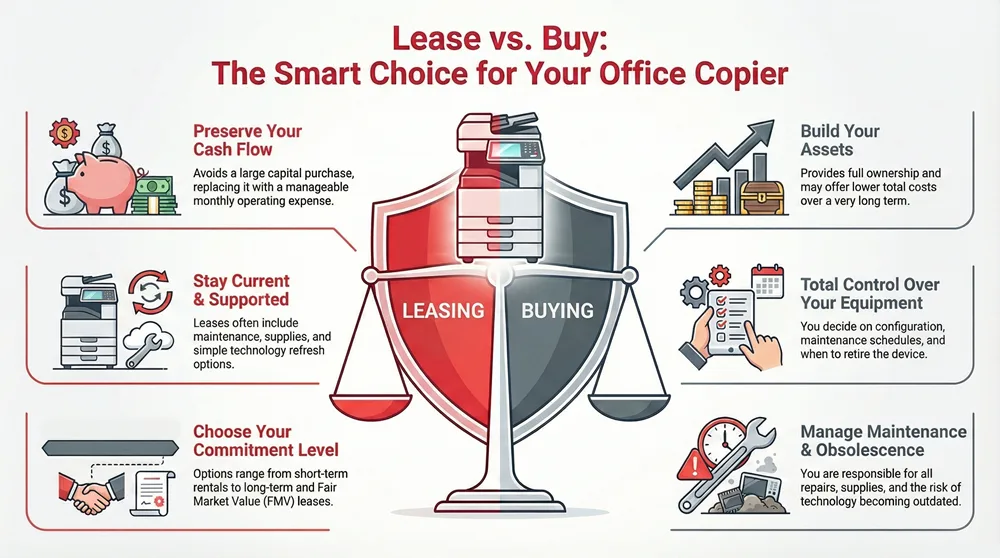
Leasing turns a large capital purchase into a predictable operating cost, improves cash flow, and preserves borrowing capacity for other priorities. Payments are spread over fixed monthly amounts and can include maintenance, supplies management, and upgrade options at the end of the term. That typically yields higher uptime, simpler budgeting, and access to current MFP features without the full upfront price. Below are the main advantages, written for quick decisions and easy comparison.
Leasing delivers these practical benefits for local companies:
- Lower upfront cost: Replace a big capital purchase with manageable monthly payments to protect working capital.
- Predictable monthly expense: Fixed payments make printing costs easier to budget and forecast.
- Included maintenance and support: Service agreements bundled with leases reduce downtime and shift repair risk to the provider.
- Easier technology refresh: Lease terms and upgrade options let you adopt secure print, remote monitoring, and other features without buying new equipment outright.
- Potential tax and accounting benefits: Payments treated as operating expenses can simplify reporting and align costs with usage. (Consult your tax advisor for specifics.)
These points lead naturally into the financial mechanics—how monthly payment structures and tax treatment affect upfront cost and accounting choices.
The table below matches leasing attributes to tangible business outcomes so you can compare at a glance.
| Leasing Attribute | Operational Impact | Business Outcome |
|---|---|---|
| Lower upfront cost | Preserves capital and borrowing capacity | Improved cash flow and investment flexibility |
| Fixed monthly payments | Stable budget line item | Better forecasting and reduced expense variance |
| Maintenance included | Less in-house support required | Higher uptime and fewer service escalations |
| Upgrade options | Smoother technology refresh cycles | Access to current features and security updates |
| Supplies management | Automated replenishment | Lower admin overhead and fewer stockouts |
This mapping shows how each leasing feature supports measurable business goals and introduces the next section on cash-flow mechanics.
How Does Leasing Reduce Upfront Costs and Improve Cash Flow?
Leasing replaces a single large capital expense with predictable monthly payments that, in many cases, are treated as operating costs. That keeps cash on hand and preserves borrowing capacity for growth or other priorities. For example, a mid-volume MFP that would require a substantial purchase can instead be leased with payments tied to expected print volumes, aligning expense timing with usage. The result is simpler budgeting across fiscal periods and less immediate pressure on the balance sheet—important for Augusta companies managing capital allocation. This naturally leads into tax implications and a direct comparison with buying.
What Tax Advantages Does Copier Leasing Offer in Augusta?
Leasing can simplify tax treatment because payments are often recorded as operating expenses, which may reduce taxable income in the period payments are made. A purchase, by contrast, uses depreciation schedules and capital expense rules that spread tax effects across years. Many businesses prefer the predictable expense recognition a lease offers, but local tax rules and company accounting policies vary—consult a tax professional to confirm how leasing applies to your situation. With tax considerations in mind, you can better weigh leasing versus buying as you review lease types and sales options below.
Which Copier Leasing Options Are Available in Augusta, GA?
Local providers offer several lease and subscription models to match different rhythms and budgets: short-term rentals, long-term leases, Fair Market Value (FMV) agreements, and subscription-based print services. Short-term rentals favor seasonal or temporary needs, long-term leases reduce monthly rates through extended commitments, FMV leases pair lower payments with flexible end-of-term choices, and subscription models bundle devices, supplies, and managed services into one monthly fee. Short descriptions and a comparison table help you spot the model that fits your goals.

Common lease types and what they mean:
- Short-term copier rental: Temporary equipment for seasonal demand or short projects—fast deployment with minimal commitment.
- Long-term lease: Multi-year agreements with lower monthly payments, ideal for steady, predictable volume.
- Fair Market Value (FMV) lease: Lower monthly payments based on expected residual value, with multiple choices at term end.
- Subscription-based model: All-in-one monthly plan that includes device access, supplies, and managed print services.
The table below compares lease types by term, typical cost range, and best use cases to help you pick the right structure.
| Lease Type | Typical Term | Typical Monthly Range | Best For |
|---|---|---|---|
| Short-Term Rental | 1–12 months | Flexible, higher per-month | Seasonal projects, temporary locations |
| Long-Term Lease | 3–5 years | Lower monthly cost | Stable, high-volume offices seeking lower TCO |
| Fair Market Value (FMV) | 2–5 years | Competitive, residual-based | Firms needing upgrade flexibility at term end |
| Subscription Model | 1–3 years (rolling) | All-inclusive monthly fee | Organizations wanting predictable bundled services |
This side-by-side view clarifies tradeoffs between flexibility, monthly cost, and upgrade paths, and it leads into differences between short- and long-term arrangements.
Local providers typically back these lease types with on-site installation and responsive service. Automated Business Machines (ABM), a locally owned partner serving Georgia and Alabama, is an example of a vendor that structures flexible leases and supports local installation and maintenance to meet each model’s expectations.
What Are the Differences Between Short-Term and Long-Term Leases?
Short-term leases prioritize flexibility and quick deployment—good for seasonal peaks, temporary locations, or pilot programs. They usually cost more per month but avoid long commitments. Long-term leases spread costs over several years to lower monthly payments and improve total cost of ownership for steady environments. The tradeoff is less agility to change device types mid-term, so businesses that expect fast growth or rapid technology change may prefer shorter terms or FMV options. Weighing those tradeoffs helps you balance cost efficiency and flexibility.
How Do Fair Market Value Leases Work for Augusta Companies?
An FMV lease sets payments using the equipment’s projected residual value at lease end, which typically results in lower monthly payments versus a capital lease. At the end of the term you can usually return the device, renew or extend the lease, or buy the equipment at fair market value. FMV suits organizations that want predictable operating costs and upgrade flexibility without committing to ownership. The FMV lifecycle includes estimating usage, agreeing a residual, scheduling payments, and deciding at maturity—which makes FMV attractive when refresh flexibility matters.
Further research explains the financial principles behind fair market valuation in lease-to-own agreements and their potential benefits.
Fair Market Valuation for Lease-to-Own Agreements
A careful valuation of lease-to-own rights helps determine the economic benefits and accounting recognition of those rights. This research outlines methods for identifying and measuring those values, describes the financial implications for the parties involved, and presents approaches to allocating benefits and obligations under leasing agreements that include purchase options.
Principles of fair market valuation of rights under leasing agreement with the option to purchase the property, 2020
What Copier Sales Solutions Does Automated Business Machines Provide in Augusta?
Automated Business Machines (ABM) stocks new and certified used copiers, sales packages, and support plans that match different ownership preferences and budgets. Buying is a good choice for organizations that prefer asset ownership, long-term depreciation, or specific device configurations. ABM pairs sales with service agreements and supplies programs so purchases stay productive after the sale, reducing the friction of ownership. Below is a clear comparison of product categories and how they align with buyer needs, followed by brand-level guidance to help procurement decisions.
The table below compares product categories by brand examples, sale or lease availability, and key benefits to help buyers identify the right devices for their volumes and workflows.
| Product Category | Brand/Model Examples | Sale Price Range or Lease Availability | Key Benefits |
|---|---|---|---|
| Entry-level MFPs | Entry color laser models (Toshiba, Lexmark, HP) | Purchase or lease options | Affordable, compact footprint for small offices |
| Mid-volume copiers | Mid-tier Toshiba and Lexmark models | Purchase or lease | Balanced speed, color quality, and cost |
| High-volume MFPs | Heavy-duty Toshiba/HP systems | Purchase or lease | High throughput, advanced finishing, reliable performance |
| Certified Used Copiers | Refurbished models from major brands | Purchase with service options | Lower purchase price with warranty-backed support |
This table clarifies how new and used options align with business scale and sets up brand-focused guidance below.
Which New and Used Office Copiers Are Available for Purchase?
New models range from compact entry-level MFPs to high-capacity systems that emphasize speed, color fidelity, and built-in security for modern workflows. Certified used units give a lower-cost path to similar functionality; they’re refurbished, tested, and often sold with limited warranties to reduce buyer risk. Buying new gives the longest manufacturer warranty and easier access to current integrations, while used purchases offer immediate savings for budget-conscious operations. Service plans covering installation, preventive maintenance, and supplies replenishment help keep both new and used devices productive after purchase.
How Do Toshiba, Lexmark, and HP Copiers Meet Augusta Business Needs?
Toshiba is frequently chosen for durability and heavy-volume reliability—good for operations that demand robust finishing and steady throughput. Lexmark balances image quality and cost-effectiveness, appealing to mid-market offices that need strong security and streamlined workflows. HP stands out for color accuracy, cloud integration, and managed print compatibility, fitting organizations that prioritize mobile printing and remote management. Each brand maps to specific use cases—heavy throughput, balanced TCO, or cloud-first workflows—so match brand strengths to your workload and IT goals.
Next, we cover how repair and managed services reduce downtime and lower your total printing costs.
How Can Augusta Businesses Benefit from Copier Repair and Managed Print Services?
Timely repair services and Managed Print Services (MPS) both raise uptime and lower total cost of ownership by combining fast technical response, supplies management, and usage optimization. Emergency repair fixes immediate faults—paper jams, hardware failures, or network issues—while MPS takes a proactive approach with fleet assessments, remote monitoring, and policy enforcement to reduce waste and optimize device placement. Together, these services produce measurable results like shorter repair times, less supplies waste, and actionable reporting on print behavior. The sections below outline common emergency repair features and how MPS drives continuous improvements.
The following list summarizes typical emergency repair services so procurement and IT leaders understand what support looks like.
- Rapid triage: An initial diagnosis during a service call to gauge severity and estimate repair time.
- On-site technician repairs: Certified technicians perform hardware fixes and parts replacement when needed.
- Remote troubleshooting: Network and driver issues resolved remotely when possible to speed recovery.
- Follow-up verification: Post-repair checks confirm device performance and help prevent repeat issues.
These emergency steps reduce downtime and protect document workflows, and they lead into how a managed print program proactively lowers the need for emergency visits by addressing root causes and usage patterns.
What Emergency Copier Repair Services Are Offered in Augusta?
Emergency repair typically includes fast triage, parts replacement, firmware updates, and network reconfiguration to get devices back online quickly. Providers usually follow a workflow of remote diagnosis, on-site dispatch if required, repair and parts replacement, and documented follow-up to confirm stability. Quick response minimizes disruption and keeps departments productive—especially teams that rely on consistent print and scan functions. A local service presence and certified technicians improve parts availability and appointment speed, and that reliability complements MPS programs designed to reduce emergencies.
How Do Managed Print Services Optimize Printing Costs and Workflow?
MPS starts with a fleet assessment to measure devices, usage patterns, and cost drivers, then creates a plan that can include meter-based billing, automated supplies, policy enforcement, and reporting dashboards. MPS lowers total cost of ownership by optimizing device placement, consolidating underused machines, and enforcing secure print policies to cut wasteful color use. Common KPIs include cost per page, volume reduction, and supply consumption—metrics tracked monthly to show progress. Remote monitoring enables proactive maintenance, fewer emergency calls, and longer device life. These MPS insights also help you decide whether to lease or buy devices.
An empirical study examines managed print services pricing and contractual interactions to highlight provider–customer dynamics.
Managed Print Services Pricing & Customer Contract Analysis
This study analyzes managed print services (MPS) contracts and pricing using proprietary data. It finds customer printing demand is largely insensitive to service price across observed contracts and shows that individual customers’ valuation of MPS tends to reflect the broader market, despite differences in industry and negotiation. The research highlights how contractual design and pricing shape provider–customer outcomes in MPS agreements.
Empirical study on managed print services pricing, J Ning, 2014
What Should Businesses Consider When Choosing Between Leasing and Buying Copiers in Augusta?
The right choice depends on budget, growth plans, refresh cycles, tax treatment, and how much control you want over hardware. Leasing suits organizations that prioritize cash flow, predictable operating costs, and frequent upgrades. Buying fits organizations expecting long-term heavy use that prefer ownership benefits like depreciation. Consider total cost of ownership, refresh flexibility, maintenance commitments, and business continuity—especially for regulated workflows. Below are concise pros and cons and a short checklist to guide your decision.
The following list presents high-level pros and cons to quickly weigh leasing versus buying.
- Pros of Leasing: Lower upfront cost, predictable monthly payments, bundled maintenance, and easier upgrades.
- Cons of Leasing: Long-term payments may exceed purchase cost over many years and you don’t own the asset.
- Pros of Buying: Ownership, potential long-term savings, and full control over configuration and retirement.
- Cons of Buying: Larger initial capital outlay, responsibility for maintenance and obsolescence, and more complex depreciation accounting.
In short: if preserving capital and staying current with technology matter most, leasing is attractive; if long-term ownership and lower recurring payments are priorities, buying may be better.
How Does Leasing Compare to Buying in Terms of Cost and Flexibility?
Leasing usually offers lower initial cost and greater flexibility because payments can include service and upgrade options, reducing the need for large replacement reserves. Buying can be less expensive over a long horizon if equipment remains productive beyond typical lease cycles and maintenance is managed well. Leasing suits fast-growing or changing businesses that need frequent upgrades; buying suits stable organizations with in-house maintenance. A simple numeric comparison shows how monthly lease payments fit operational budgets while purchases require capital outlay—an important consideration as industry trends shape acquisition choices.
Managing rapid technology change and preventing obsolescence is key to controlling costs—another reason flexible acquisition models are valuable.
Technology Refresh & Obsolescence Management for Cost Control
Rapid technology change shortens component lifecycles and can quickly create obsolescence risks. Design refresh planning helps manage those risks and minimize total cost. This work presents models for scheduling refreshes to control cost while maintaining operational capability.
Technology Refresh A System Level Approach to Managing Obsolescence, 2006
What Are the Latest Industry Trends Affecting Copier Acquisition Decisions?
Key trends include subscription and service-based models that bundle devices with MPS, stronger emphasis on built-in security and compliance, and remote monitoring for proactive maintenance. Mobile/BYOD printing, cloud integrations, and tighter software-driven workflows mean vendor selection now involves more than hardware specs. As MPS adoption grows, organizations increasingly value providers that support both leasing and purchasing with strong local service and reporting capabilities.
For Augusta organizations evaluating options, Automated Business Machines (ABM) offers integrated choices across leasing, purchasing, repair, and managed print services and can provide consultative quotes and on-site assessments to align device strategy with your objectives. ABM is locally owned and operates in Georgia and Alabama, emphasizing flexible solutions, free installation with supported plans, and responsive local service. If you’d like a quote, consultation, or fleet assessment to compare leasing and buying scenarios, connecting with a local provider experienced in Toshiba, Lexmark, and HP can speed your decision.
Frequently Asked Questions
What factors should businesses consider when selecting a copier leasing provider?
Look at reputation and response times—fast, local support is essential to minimize downtime. Review lease flexibility (upgrade options and term adjustments), examine the total cost (including overage fees and supplies), and confirm the provider offers equipment that matches your speed, volume, and security needs.
How can businesses determine the right copier for their needs?
Start by measuring average monthly print volume and whether you need color. Consider document types—marketing materials need better color fidelity than internal forms—and required features like scanning, finishing, and wireless or cloud connectivity. A provider can map your workflow to device capabilities and future growth.
What are the common pitfalls to avoid when leasing a copier?
Don’t focus only on the monthly payment—factor in total cost of ownership including maintenance, supplies, and overage fees. Read lease terms carefully to avoid surprises, avoid locking into long leases if your needs may change, and verify the provider’s service coverage before signing.
How does copier leasing impact a company’s balance sheet?
Leasing can improve short-term cash flow by shifting a capital purchase to operating expense, which may preserve borrowing capacity and simplify reporting. Effects on financial statements depend on lease type and accounting rules—consult your financial advisor to understand implications for your organization.
What should businesses know about the end-of-lease options?
At lease end you typically can return the equipment, renew or extend the lease, or purchase the device at fair market value. Some agreements include upgrade paths to newer models. Review the contract’s end-of-term terms so you’re prepared for each option.
How can businesses ensure they are getting the best deal on copier leasing?
Compare multiple providers for transparent pricing and service terms. Negotiate payment schedules, maintenance coverage, and overage rates. Evaluate total cost of ownership over the lease and consider referrals or local reputation when choosing a partner.